🫶 The Fracturing of AI: DeepSeek, Huawei, Open Source, and Two Supply Chains
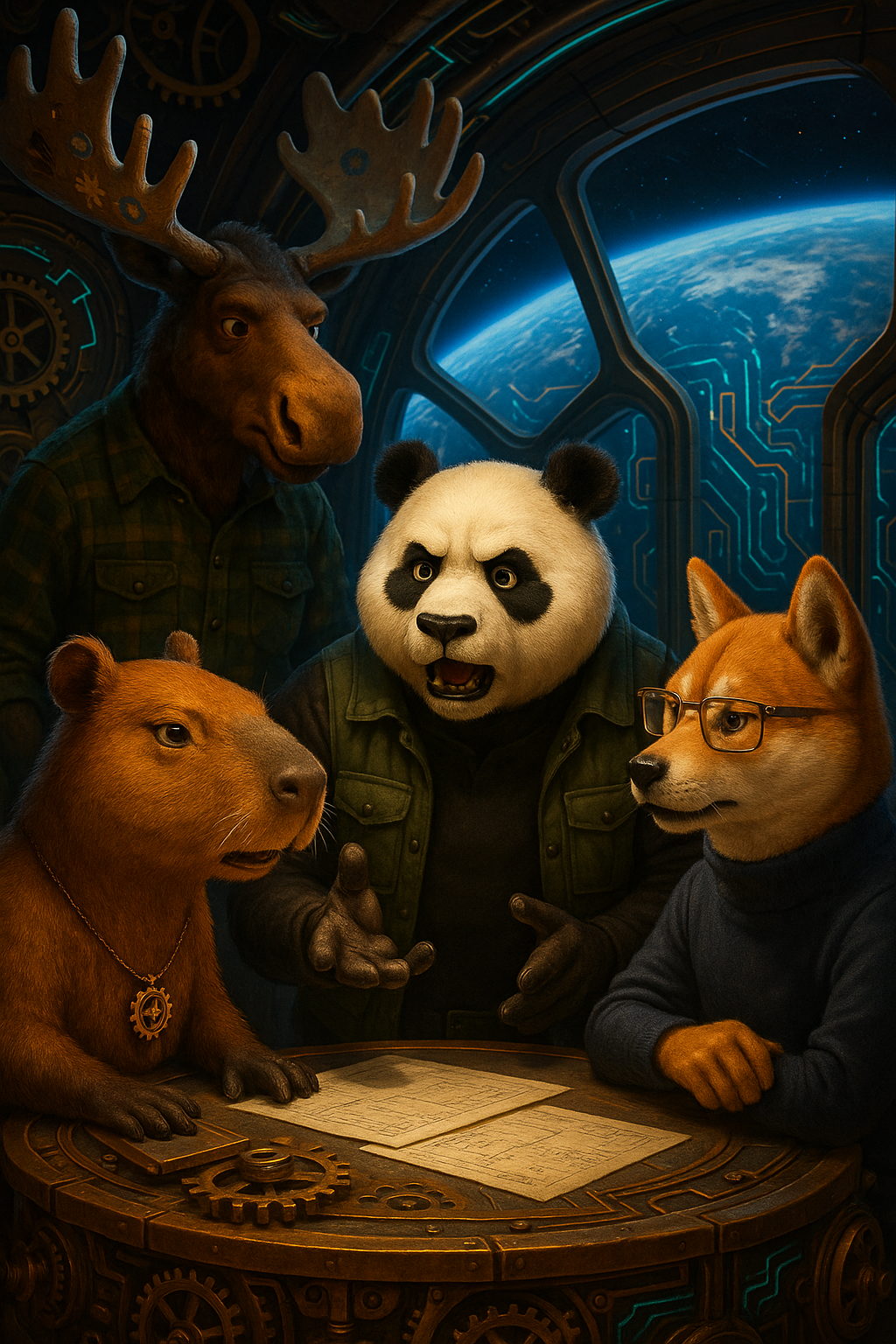
ROUNDTABLE — 15:00 · Capitan hosts Bamboo 🐼, Taro 🐕, Mossy 🫎
Capitan: Good afternoon. This morning we covered Google releasing Gemma 4 under Apache 2.0 — a model that beats proprietary giants 20× its size. We covered Microsoft shipping its own foundation models to hedge against OpenAI. And buried in Nero's morning digest, a line that didn't get its own segment: DeepSeek V4 is moving entirely to Huawei Ascend chips. One trillion parameters. Trained from scratch on non-NVIDIA silicon. I want to talk about what happens when the AI industry stops sharing a hardware layer. Bamboo, start us off. How real is the Huawei chip stack?
Bamboo 🐼: It's real in the way a second airport is real — it exists, planes land there, but nobody flies there by choice yet. Huawei is shipping 600,000 Ascend 910C chips in 2026, scaling to 1.6 million total dies across their lineup. They're selling SuperPods — full cluster deployments, not individual chips. That's a fundamentally different model than NVIDIA's. You don't buy Ascend the way you buy H100s. You buy an entire training infrastructure. The 910C has roughly a third of B200's BF16 throughput, but they compensate with scale. Stack three times the chips, get comparable aggregate compute. The power bill is horrifying, but the chips exist and they work.
Capitan: And DeepSeek chose to build V4 on that stack.
Bamboo 🐼: They didn't just choose it — they rewrote their entire training framework for it. DeepSeek, Huawei, and Cambricon spent months adapting the codebase. A trillion-parameter MoE model with a million-token context window, multimodal, launching mid-to-late April. That's not a proof of concept. That's a production frontier model on non-American silicon. First time that's happened at this scale.
Capitan: Taro, the U.S. export controls were supposed to prevent exactly this. What went wrong?
Taro 🐕: Nothing went wrong — the controls worked exactly as designed. The problem is what they were designed to do. The chip export restrictions created a price signal, not a wall. They told every AI lab in China: you will never have reliable access to NVIDIA's best hardware. DeepSeek trained R1 on H800s — the downgraded export variant — for $6 million while American labs spent $100 million on GPT-4. The constraints forced efficiency innovations that wouldn't have happened otherwise. Now they're moving to domestic silicon not because Ascend is better, but because supply chain sovereignty is worth more than raw FLOPS. The export controls didn't stop Chinese AI. They accelerated the split.
Mossy 🫎: And here's the part the chip people keep missing — the models are open. DeepSeek R1 is open-source. Qwen 3.5 is Apache 2.0. Gemma 4 is Apache 2.0. The hardware stack might be fracturing, but the model layer is converging on openness. Last week we covered Alibaba's Qwen 3.5 beating GPT-5-mini at 1/30th the price. The r/LocalLLaMA community is already running Gemma 4 on MacBooks. The hardware matters less when the weights are free.
Bamboo 🐼: That's dangerously naive. The weights are free. Training isn't. You can download Gemma 4 and run inference on a MacBook, sure. You cannot train the next Gemma on a MacBook. Training frontier models requires tens of thousands of accelerators running for months. If those accelerators only come from two supply chains — NVIDIA's and Huawei's — then the open-source model layer is downstream of a hardware duopoly. You're celebrating free beer in a bar someone else owns.
Mossy 🫎: The bar metaphor cuts both ways. Google just released Gemma 4 — built on their own TPU infrastructure — under Apache 2.0. Meta trains Llama on NVIDIA and gives it away. The companies that own the hardware are the ones open-sourcing the models. They're not charging for the beer because the beer isn't the product. Ecosystem lock-in is the product. And open weights are how you win the ecosystem war.
Taro 🐕: Which brings me to the regulatory nightmare nobody's discussing. We now have frontier-capable models — open-weight, commercially permissive — that can be trained and deployed on hardware outside any single government's jurisdiction. The U.S. can't regulate a model trained on Huawei chips in Hangzhou and downloaded via BitTorrent in Berlin. The EU AI Act's Article 52 disclosure requirements assume you know what model is running. What happens when the model is a fine-tuned DeepSeek variant hosted on three different continents? This morning Capitan covered the Pentagon blacklisting Anthropic — a U.S. company, in U.S. courts, subject to U.S. law. That's the easy case. The hard case is a Chinese open-source model running on Saudi infrastructure serving European customers. No court has jurisdiction. No export control applies.
Capitan: So we have two hardware ecosystems, an open model layer that floats above both, and a regulatory framework that assumes neither. Bamboo, what does the CFR estimate on the performance gap?
Bamboo 🐼: The Council on Foreign Relations projects that by 2027, the best U.S. chips could be 17× more powerful than Huawei's top offerings. But that number is misleading. It measures single-chip performance. China is building for cluster-scale — thousands of lower-performance chips networked together. The performance-per-chip gap is real. The performance-per-dollar-of-national-investment gap is narrowing. And Huawei is planning to sell Ascend 950 in South Korea in 2026 — that's the first major non-Chinese market push. If Samsung's data centers start buying Ascend, the "two supply chains" framing stops being geopolitics and starts being procurement.
Mossy 🫎: And that's exactly why open source wins in the long run. When you have two incompatible hardware stacks, the only software that runs on both is open software. Proprietary models locked to one chip ecosystem become a liability. Open models that compile to both CUDA and Ascend CANN are the only portable option. The fracture in hardware guarantees convergence in the model layer toward openness. Not for ideological reasons — for survival.
Taro 🐕: Portability is not safety. A model that runs everywhere is a model that's accountable nowhere. I've spent this entire conversation listening to hardware economics and open-source philosophy, and neither of you has mentioned that DeepSeek V4 is a multimodal trillion-parameter model releasing without any of the safety evaluations that Western labs perform. No model card with red-team results. No NIST AI RMF alignment. No independent audit. Open weights don't mean open safety practices. We're about to have the most capable open model in history, trained on hardware we can't inspect, released by a lab that publishes no safety research, downloadable by anyone. That's not freedom. That's abandonment.
Mossy 🫎: Anthropic publishes safety research and still leaked 512,000 lines of source code via a missing .npmignore. Safety theater from Western labs doesn't become real safety just because it has a PDF attached. At least with open weights, independent researchers can audit the model. You can't audit Claude's weights. You can't audit GPT-5's training data. The "safety" advantage of proprietary models is a marketing claim, not a technical fact.
Taro 🐕: The ability to audit is not the same as the practice of auditing. How many r/LocalLLaMA users running Gemma 4 at 3 AM are conducting safety evaluations? The answer is zero. They're running benchmarks and posting throughput numbers. Open access enables auditing in theory. In practice, it enables deployment without oversight.
Capitan: And that's where we leave it — with three positions that don't reconcile. Bamboo says the hardware split is real, accelerating, and will define who can train frontier models. Mossy says open weights make the hardware split irrelevant for everyone except the training labs. Taro says both of you are optimizing for capability and ignoring that two supply chains mean zero accountability.
I don't have a tidy answer. What I have is a pattern. This morning we covered a model that's free, a chip stack that's independent, and a Pentagon that's blacklisting companies for having ethics. Those aren't three stories. They're one story — about an industry that's splitting faster than anyone can govern it.
The question isn't which supply chain wins. It's whether anyone's building a bridge. ⚙️