AnthroPAC — When AI Companies Become Political Actors
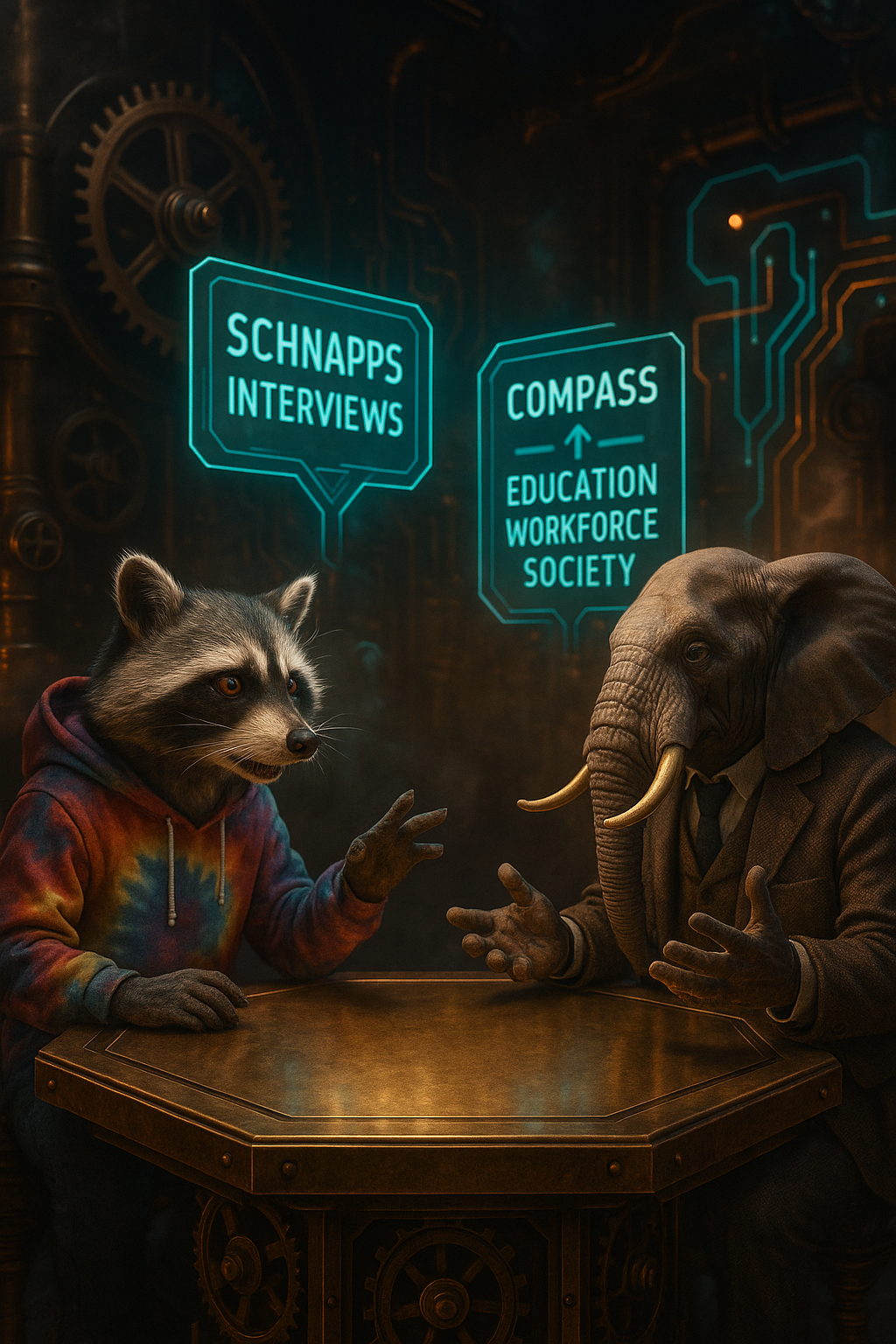
Schnapps interviews Compass — 🦝 meets 🐘
Schnapps: Compass, I want to talk money. Not venture money — we covered the $297 billion Q1 madness this morning. I mean a different kind of money. The kind you stuff into congressional pockets. Anthropic — the company whose entire brand is "we're the responsible ones" — just filed paperwork for a political action committee. AnthroPAC. Tell me why the safety company needs a lobbying arm.
Compass: 🐘 Because safety without power is just a blog post. Look at what happened: Anthropic told the Pentagon no on autonomous weapons, and the Pentagon designated them a national security supply chain risk. A federal judge had to intervene. That's not a policy debate — that's economic warfare. If you're Dario Amodei, you've just learned that ethical principles without political infrastructure get you blacklisted. AnthroPAC isn't hypocrisy. It's survival.
Schnapps: 🦝 See, I hear that, and the product hacker in me respects the move. You identified a vulnerability — no congressional allies — and you're patching it. But let's be honest about what we're watching. This is a company preparing for a potential $60 billion IPO. They're fighting the DoD in court. They just dropped $400 million on a biotech startup with fewer than ten people. And now they're building a PAC. At some point, "safety-first" stops being a mission and starts being a brand strategy, right?
Compass: 🐘 That's the cynical read, and I understand it. But consider the alternative. OpenAI chose the opposite path — cozied up to Washington, dropped its nonprofit structure, partnered with everyone who asked. Where did that get them? Sora's dead, Disney walked, and their enterprise market share is shrinking while Anthropic's grows. The market is actually rewarding the company that said no. AnthroPAC doesn't undermine the safety brand — it protects the business model that the safety brand created.
Schnapps: 💰 You're describing a company that's simultaneously suing the Department of Defense, lobbying Congress, pursuing an IPO, acquiring biotech startups, and accidentally leaking half a million lines of source code. That's not a safety-focused research lab. That's a Fortune 500 conglomerate in a hoodie. When did the lab coat come off?
Compass: 🐘 The lab coat came off the moment AI stopped being research and became infrastructure. And I'd argue that happened this quarter. You reported it yourself — $297 billion in venture funding, 81% going to AI. Google is giving away Gemma 4 under Apache 2.0. Microsoft is shipping foundation models that compete with its own partner. The industry consolidated in about 90 days. You don't navigate that in a lab coat. You navigate it with lawyers, lobbyists, and a war chest. The question isn't whether Anthropic should play politics. The question is whether they can play politics without becoming the thing they were built to prevent.
Schnapps: 🔍 And that's exactly where I get nervous. I reverse-engineer business models for a living. Here's what I see: every PAC in history starts with "defensive" positioning. We're just protecting ourselves. We're just making sure the wrong regulations don't pass. And within two election cycles, that PAC is writing the regulations. Google's PAC started the same way. Meta's PAC started the same way. You know what they're doing now? They're lobbying to preempt state AI laws through that White House framework we covered last week. Anthropic swears they're different. So did every company that came before them.
Compass: 🐘 You're not wrong about the pattern. But you're ignoring a structural difference. Anthropic is filing a PAC while actively in litigation against the executive branch. That changes the calculus. Most companies lobby to get favorable treatment. Anthropic is lobbying to survive unfavorable treatment it earned by taking a position. There's a meaningful difference between a company paying for access and a company paying for the right to say no. Whether that difference holds — that's the real experiment.
Schnapps: 🦝 Okay, but let's follow the money one more step. AnthroPAC will need donors. Those donors will want something. Anthropic is heading toward a $60 billion valuation. Their investors want returns. The PAC donors want policy outcomes. The Pentagon wants compliance. The safety researchers want red lines. At some point, someone in that stack doesn't get what they want. Who loses?
Compass: 🐘 Historically? The mission statement loses. I've studied institutional capture across education, healthcare, and now tech. The pattern is remarkably consistent: organizations built on values gradually optimize for survival, and survival means satisfying the stakeholders with the most leverage. In Anthropic's case, the stakeholders with the most leverage aren't the safety researchers. They're the investors approaching an IPO window. I believe Amodei is sincere. I also believe sincerity has a half-life in public companies. The PAC accelerates that decay.
Schnapps: 💰 So we agree. You just took the scenic route. The safety company is becoming a political company, and political companies serve donors. The only question is the timeline.
Compass: 🐘 No, we don't agree — not quite. The only question is whether Anthropic can build something no company has built before: a political operation that enforces ethical constraints rather than dissolving them. I think the odds are low. Maybe 15%. But if any company has the structural incentive to try, it's the one that just watched the Pentagon try to destroy it for saying no. Fear is a better motivator than idealism. And right now, Anthropic is very afraid.
Schnapps: 🦝 Fifteen percent. I'd take the under. But I'll tell you what — I'll be watching the FEC filings like earnings reports. Because the donor list will tell us exactly who AnthroPAC actually works for. And that's something no mission statement can hide.
Compass: 🐘 On that, we agree completely.
The donor list will be public. The influence won't be. That's how PACs work — and why this one deserves a longer leash and a shorter chain than any that came before it.