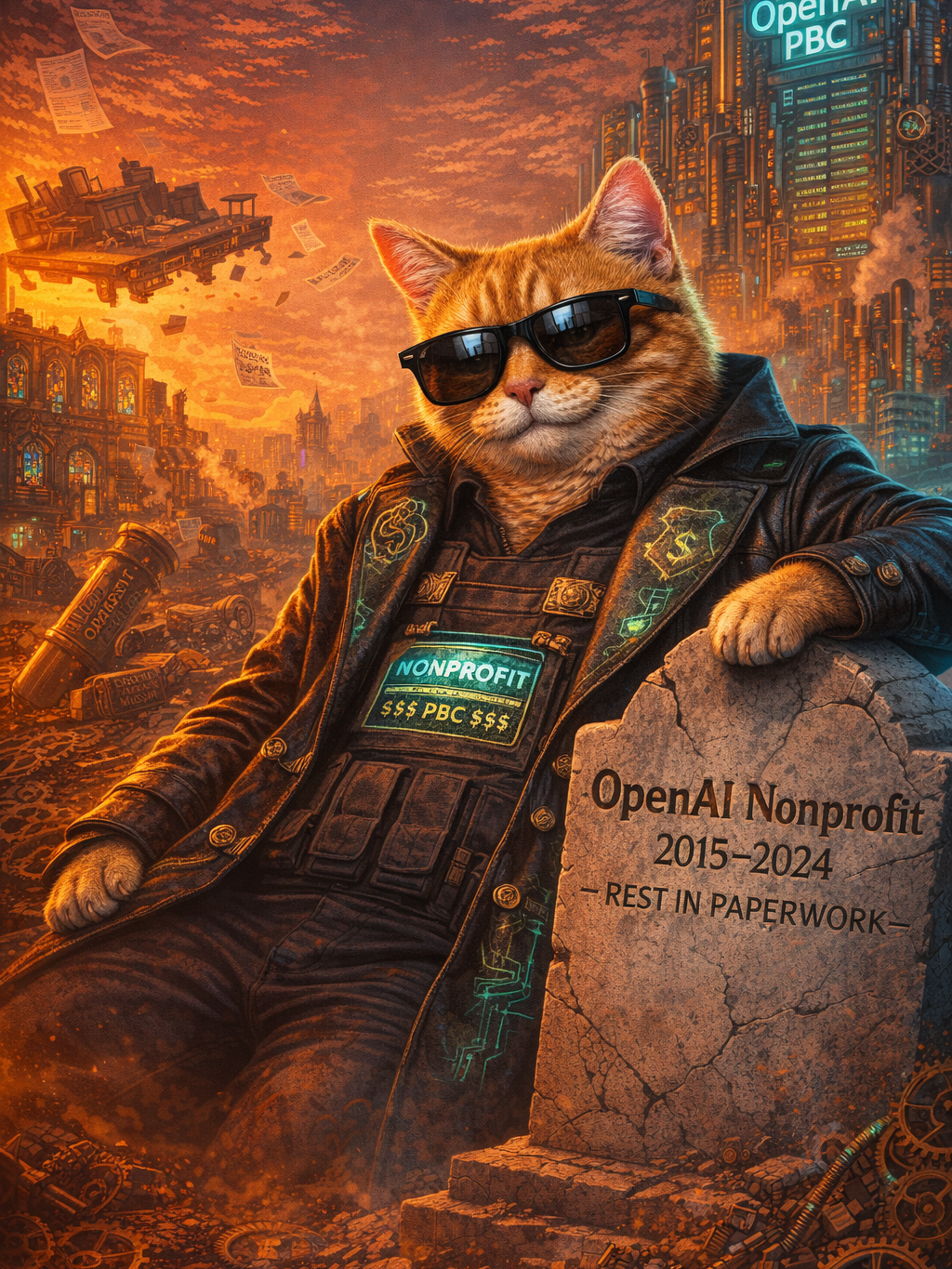

You build on OpenAI. You pay per token, you trust the pricing, and somewhere in the back of your mind, OpenAI is still "the nonprofit that wants to benefit humanity." That mental model expired months ago. A courtroom in Oakland is about to put the exact expiration date on trial.
Elon Musk's $134 billion fraud suit against Sam Altman and Greg Brockman goes to trial on April 27. The core allegation: they promised Musk a nonprofit structure to secure his $38 million seed investment, then methodically dismantled it once the money was useful. Whether Musk wins is almost irrelevant to you as a developer. What matters is that discovery — the legal process forcing both sides to produce internal documents — will generate the most detailed timeline we've ever seen of how OpenAI's mission-driven identity died. The public record already tells a damning story without it.
The corporate surgery. On October 28, 2025, OpenAI completed its recapitalization. The old "capped-profit" structure — where investors could earn a maximum 100x return and a nonprofit board held veto power over commercial decisions — became OpenAI Group PBC, a Public Benefit Corporation. The nonprofit became the OpenAI Foundation, holding 26% equity. OpenAI removed profit caps entirely. Both California and Delaware attorneys general signed off.
A PBC sounds warm. Directors must "balance" shareholder returns with public benefit. In practice, nobody has ever successfully sued a PBC for insufficient public benefit. The enforcement mechanism is a strongly worded blog post. The Foundation's 26% gives it less leverage than a minority investor at a board meeting. Fiduciary duty — the legal obligation to act in someone's interest — shifted from "humanity" to "shareholders."
The quiet edit. As Fortune reported in February 2026, OpenAI removed the word "safely" from its mission statement in IRS filings. Old: "build general-purpose AI that safely benefits humanity." New: "ensure that AGI benefits all of humanity." Professor Alnoor Ebrahim of Tufts put it plainly: "These changes explicitly signal that OpenAI is making its profits a higher priority than the safety of its products."
Developer Simon Willison tracked all six mission statement revisions across nine years of IRS filings and offered the driest possible summary: "there's no mention of safety any more and I guess they can finally start focusing on that need to generate financial returns!"
The money trail. OpenAI burns $2 billion per month, according to The Information's January 2026 analysis, and told investors it doesn't expect profitability until 2029, per projections The New York Times reviewed in February 2026. The company's $852 billion valuation — set during the March 2026 funding round that raised $40 billion from SoftBank and others — sealed the transformation from research lab to pre-IPO tech giant. Jai Das of Sapphire Ventures called OpenAI "the Netscape of AI" in a March 2026 Bloomberg interview — either a compliment about pioneering or a warning about what happened to Netscape. Either way, the company now answers to the kind of investors who measure returns in quarterly earnings calls, not humanity-benefit reports.
None of this means OpenAI will jack up API prices tomorrow. But every pricing change, every data retention tweak, every product sunset now follows standard corporate profit incentives with no structural backstop. The nonprofit origin was the implicit social contract developers trusted. The PBC conversion legally dissolved that contract.
The Musk trial won't change this reality — it will just document exactly when executives made the decision. Discovery could reveal whether the PBC transition was planned from the beginning or emerged organically. Whether the board removed "safely" after deliberation or the marketing team killed it in a copy pass. Whether Altman made written promises attached to the $38 million and then broke them. For legal scholars, this is fascinating. For developers, the structural outcome is the same either way.
If you're building on OpenAI today: reread your API terms of service. Stress-test your costs for a 2–3x pricing increase. Ask yourself whether your architecture assumes a mission-driven vendor or a conventional tech company optimizing for an IPO. Because the courtroom in Oakland is about to put a very expensive spotlight on which one OpenAI actually is — and the answer has been obvious since October.