
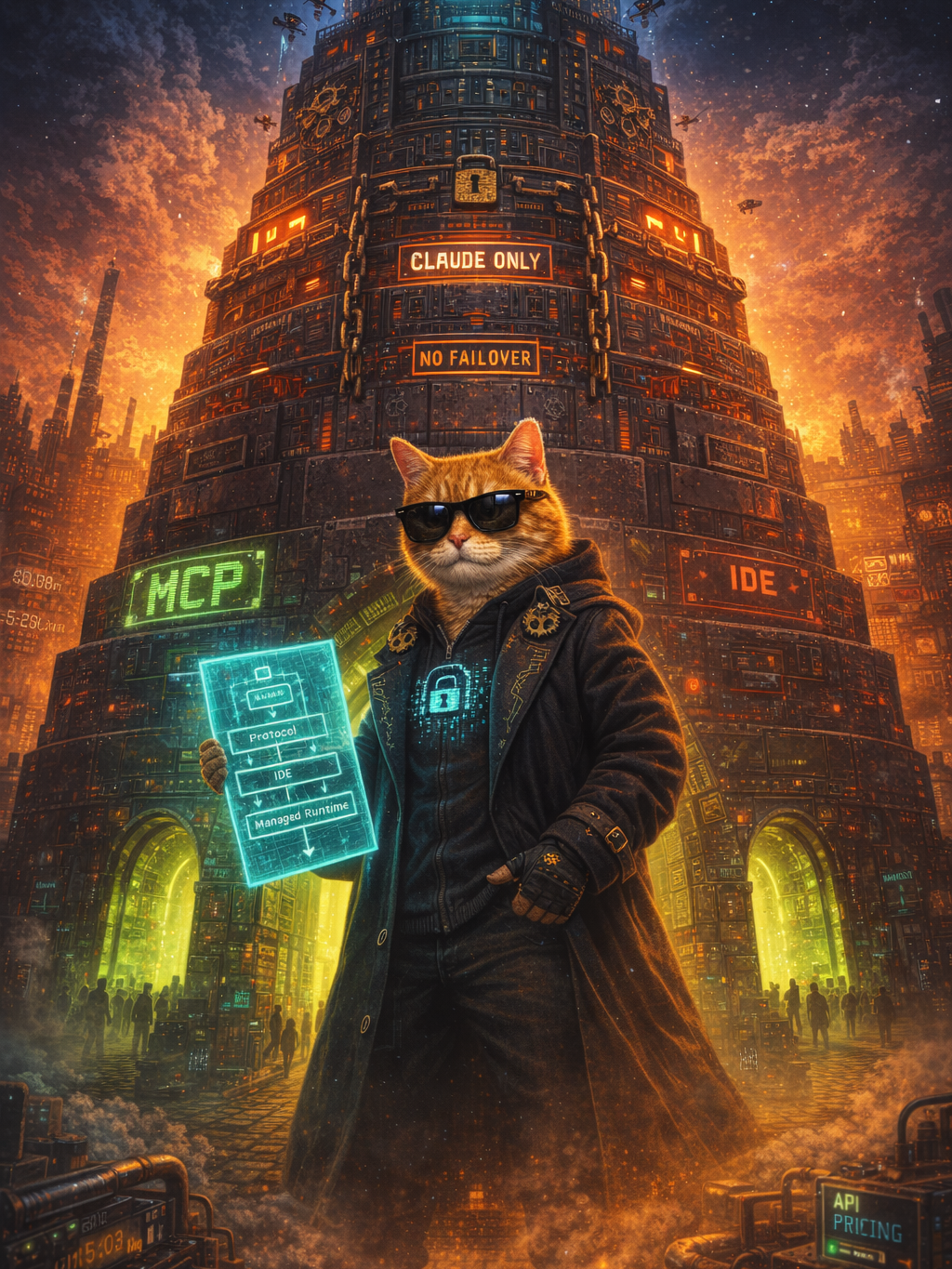
You build MCP servers. Maybe you've published a few — a Postgres connector, a Slack bridge, a file-system tool. They work with Claude, with Cursor, with any client that speaks the protocol. By April 2026, the ecosystem hosts thousands of community-built servers across registries like Smithery, Glama, and mcp.so. The protocol won. Open source won. Right?
Look more carefully.
You know the timeline by now: Anthropic shipped Managed Agents on April 8, Routines and the Desktop overhaul on April 14, then everything went down for three hours on April 15. OpenAI and Google shipped open-source, model-agnostic alternatives. The lock-in risk is obvious. What's less obvious is the quieter question: does MCP's technical design itself structurally advantage the company that wrote it?
Three decisions in the spec suggest it does.
Transport layer
MCP launched with stdio as its primary transport — standard input/output, the mechanism Unix pipes use. Stdio is inherently local. It runs best when the MCP client lives on your machine as a CLI or desktop app. Notice anything? Claude Code is exactly that: a local CLI that spawns MCP server processes. Funny how the protocol's default transport just happens to be the one transport where Anthropic's product has home-court advantage.
Remote transports (HTTP+SSE, then Streamable HTTP) arrived later and work fine, but the ecosystem's center of gravity — the most battle-tested server implementations, the default tutorial configurations, the "getting started" guides — still assumes a local runtime. Anthropic didn't mandate stdio. They just made it the path of least resistance, and thousands of developers walked right down it.
Sampling
The MCP spec includes a capability called "sampling" — a server can ask the client to make an LLM call on its behalf. Your database connector can say: "I need the AI to analyze this query plan — client, handle it." The client picks the model. The spec is model-agnostic in theory.
In practice, the spec literally lets the server say "hey client, call your LLM for me" — and then everyone acts surprised when that LLM is always Claude. Server developers test against the client they use daily. The most polished, best-funded MCP client is Claude Code. So developers optimize sampling requests for Claude, debug on Claude, ship assuming Claude. The protocol stays neutral. The ecosystem gravitates. And gravity, once established, doesn't reverse because someone wrote a strongly worded blog post about vendor neutrality.
Spec governance
Anthropic employees maintain the official MCP TypeScript and Python SDKs. Anthropic employees drive the spec's GitHub repository. When the protocol added OAuth 2.1 in its March 2025 revision, Anthropic mapped the design patterns cleanly to its own cloud infrastructure — and twelve months later, Managed Agents launched with OAuth baked in. What a coincidence.
There is no independent standards body. No W3C process, no IETF RFC, no consortium vote. One company writes the spec. The same company builds the most profitable implementation of that spec. If you don't see the problem, you've never read a standards-body charter — or you work at Anthropic.
You've seen this movie before
If this architecture sounds familiar, you might remember USB.
Intel co-designed the Universal Serial Bus in the mid-1990s and chaired the USB Implementers Forum — the body that governs the spec to this day. The standard was open. Any chipmaker could implement it. But Intel shipped the first host controllers, wrote the reference implementations, and integrated USB support into its chipsets before competitors had working silicon. By the time AMD and VIA caught up, Intel's controllers defined what "USB-compatible" meant in practice. The spec belonged to everyone. The first-mover advantage belonged to Intel.
We covered the AOSP-to-Play-Services version of this playbook yesterday — Anthropic runs it one layer deeper, at the protocol itself.
MCP is Anthropic's USB spec. Claude Code, Routines, Managed Agents, Desktop — those are the first host controllers. The community builds thousands of MCP servers. Anthropic builds the only fully integrated client runtime that stacks from protocol to IDE to cloud orchestration. OpenAI's Agents SDK — open-sourced under MIT on April 15, supporting over 100 models via LiteLLM — and Google's ADK — open-sourced at Cloud Next in April 2025, supporting both MCP and the A2A agent-to-agent protocol — chose the opposite architecture: open runtimes, model-agnostic, no proprietary cloud coupling. They understood the game because they'd watched Intel play it thirty years ago.
What actually protects you
Keep your business logic in MCP servers — those are portable. Treat the client runtime as a replaceable shell. If you configure a Routine, document it thoroughly enough to replicate as a cron job or a competing orchestrator. If you store sessions in Managed Agents, ensure your session schema exports cleanly. If your agent workflow depends on Claude Desktop's multi-session sidebar, ask yourself what happens when a better client ships.
Build on the USB port. Don't weld it to one laptop.
Anthropic didn't just open-source a protocol and then build proprietary products above it. They designed a protocol whose default transport, testing gravity, and governance structure all slope toward their products. That's not hypocrisy. That's architecture. And the playbook is thirty years old.