
The Fifty-X Gap
Anthropic built the best coding agent on the market and then, in a move that either represents supreme confidence or spectacular self-sabotage, made it work with competing models. Claude Code's alternative provider support means you can swap Opus 4.5 — at $15 per million input tokens — for Qwen 3.6-Plus at $0.29, or run Gemma 4 locally for the price of electricity. The 50x price gap between Anthropic's flagship and Alibaba's challenger isn't a curiosity. It's an arbitrage opportunity that the market will exploit ruthlessly, and Anthropic handed developers the tool to do it.
The Architecture of Self-Disruption
Claude Code is, at its core, an agentic loop — the model reads context, reasons about it, calls tools, evaluates results, and repeats until the task is done. The model is the brain; Claude Code is the body. And bodies are model-agnostic by design.
Pointing the API endpoint at an OpenAI-compatible provider takes about 90 seconds of configuration. Qwen 3.6-Plus speaks the same tool-calling protocol. Gemma 4, served through Ollama or vLLM (a high-performance inference server for running models locally), does the same. The agent loop doesn't care whose weights are doing the thinking — it cares that the function calls come back correctly formatted and the reasoning is coherent enough to make progress.
This is not an accident. Anthropic wants Claude Code adoption because adoption drives ecosystem lock-in at the tool layer even as the model layer becomes interchangeable. It's the Android strategy: win distribution, worry about monetization later. Except Anthropic is simultaneously the premium model vendor AND the distribution platform, which creates a tension that would give any business strategist a migraine.
Part 1: Qwen 3.6-Plus via API — The $0.29 Contender
Let's talk numbers. According to Alibaba's release benchmarks, Qwen 3.6-Plus hits 78.8 on SWE-bench Verified — a benchmark that measures whether AI can actually fix real GitHub issues, not just pass toy coding tests — versus Opus 4.5's 80.9. That's a 2.6% gap. On Terminal-Bench 2.0 (a newer benchmark focused specifically on agentic terminal workflows), Qwen actually leads: 61.6 vs 59.3, per the same release data. Function calling? Qwen tops BFCL-V4 — the standard benchmark for how well models handle structured tool calls. Speed? Community reports indicate roughly 3x faster than Opus.
The pricing tells the real story:
| Opus 4.5 | Qwen 3.6-Plus | Gap | |
|---|---|---|---|
| Input | $15.00/M | $0.29/M | 51.7x |
| Output | $75.00/M | $1.15/M | 65.2x |
| Context | 200K | 1M | 5x larger |
On OpenRouter, Qwen is available at a free tier. Free. Alibaba is subsidizing inference to build ecosystem share — the same playbook that made Android the world's dominant mobile OS, and that made AWS dominant in cloud by pricing below cost for a decade.
Setup takes four lines. In your Claude Code configuration:
{
  "apiProvider": "openrouter",
  "openRouterApiKey": "sk-or-your-key-here",
  "openRouterModelId": "qwen/qwen-3.6-plus"
}
Alibaba explicitly lists Claude Code by name in their integration documentation — this isn't a hack, it's an advertised feature.
For a typical coding session that burns 2M input tokens and 500K output tokens, you're looking at $67.50 on Opus versus $1.15 on Qwen. That's not a rounding error. That's rent money.
Part 2: Gemma 4 Locally via Ollama — The Zero-Dollar Option
Google's Gemma 4, also dropped on April 2 — under Apache 2.0, as I covered this morning — offers something different: no API costs at all.
The 26B MoE model — MoE stands for Mixture of Experts, an architecture that only activates a fraction of its total parameters per query, which is why big models can run on small hardware — does 12 tokens per second on a MacBook Air with 32GB RAM. Only 3.8B parameters activate per forward pass (one round of computation through the network) despite 26B total. The 31B dense model needs more muscle but ranks #3 among all open models worldwide, per Google's release benchmarks.
Getting it running locally is two commands:
ollama pull gemma-4-26b-it
ollama serve
Then point Claude Code at your local instance:
{
  "apiProvider": "ollama",
  "ollamaBaseUrl": "http://localhost:11434",
  "ollamaModelId": "gemma-4-26b-it"
}
That's it. You now have a fully local coding agent. No tokens leave your machine. No API bills. No rate limits. No terms-of-service anxiety about your proprietary code hitting someone else's servers.
The E2B edge model — running in under 1.5GB RAM — opens even more radical possibilities. CI/CD agents on commodity hardware. Coding assistance on air-gapped networks (systems physically isolated from the internet, common in defense and finance). Development environments in countries where API access is unreliable or restricted.
Part 3: The Decision Matrix — When Cheap Is Smart and When It Isn't
Here's where the "just use the cheap model" argument meets the wall: not all tasks are equal.
The smart workflow isn't "replace Opus entirely." It's route by complexity:
- Boilerplate, tests, docs, simple refactors → Qwen 3.6-Plus or Gemma 4 local. These tasks have clear patterns, well-defined outputs, and low ambiguity. The 2.6% SWE-bench gap is irrelevant when you're generating CRUD endpoints (create-read-update-delete — the bread and butter of backend code).
- Architecture decisions, security review, complex multi-file refactors → Opus. The reasoning depth difference surfaces on novel problems, edge cases, and tasks where a single wrong decision cascades into hours of debugging.
- Privacy-sensitive code → Gemma 4 local. Period. Your proprietary algorithms should not traverse any API, regardless of terms of service.
The cost math by task type:
| Task Type | Recommended Model | Typical Session Cost | Quality vs Opus |
|---|---|---|---|
| Test generation | Qwen 3.6-Plus | ~$0.50 | ~98% |
| CRUD scaffolding | Gemma 4 local | $0.00 | ~95% |
| Documentation | Qwen 3.6-Plus | ~$0.30 | ~97% |
| Architecture review | Opus 4.5 | ~$67.50 | 100% |
| Security audit | Opus 4.5 | ~$67.50 | 100% |
| Complex refactoring | Opus 4.5 | ~$45.00 | 100% |
Part 4: The Hybrid Workflow
A configuration that routes based on task type is the natural endpoint. Here's what a practical hybrid setup looks like — set Qwen as your daily driver and override per session:
{
  "default": {
    "apiProvider": "openrouter",
    "openRouterModelId": "qwen/qwen-3.6-plus"
  },
  "profiles": {
    "architecture": {
      "apiProvider": "anthropic",
      "model": "claude-opus-4-5-20250414"
    },
    "private": {
      "apiProvider": "ollama",
      "ollamaModelId": "gemma-4-26b-it"
    }
  }
}
Qwen handles your morning ticket queue. You switch to Opus when the PR is a cross-service auth refactor. You drop to local Gemma for anything touching proprietary algorithms. The switch is one command — /model architecture or /model private — and you're on a different brain.
A developer running 80% of tasks on Qwen, 15% on Opus, and 5% locally lands at roughly $12-15/week instead of $60-80. That's the 60-80% cost reduction the numbers promise, and it's conservative.
The Uncomfortable Math for Anthropic
Anthropic's position is paradoxical. Claude Code is arguably their best distribution vehicle — it's becoming the default agentic coding tool the way VS Code became the default editor. But every alternative provider integration dilutes their API revenue. The tool that drives adoption also drives margin compression.
The counter-argument is that developers who start with Qwen hit the ceiling on hard problems and upgrade to Opus for the tasks that matter. The "good enough pushes you to premium" theory — you appreciate the difference precisely because you've experienced the gap. Maybe. Or maybe developers discover that 95% of their workload runs fine on the cheap tier and never look back.
Alibaba is explicitly loss-leading. Google is giving the model away entirely. Anthropic charges premium prices for premium quality. That strategy works beautifully in a world without close substitutes. In a world where Qwen matches Opus within 3% on coding benchmarks — per Alibaba's own numbers, which deserve scrutiny — the word "premium" starts sounding a lot like "overpriced."
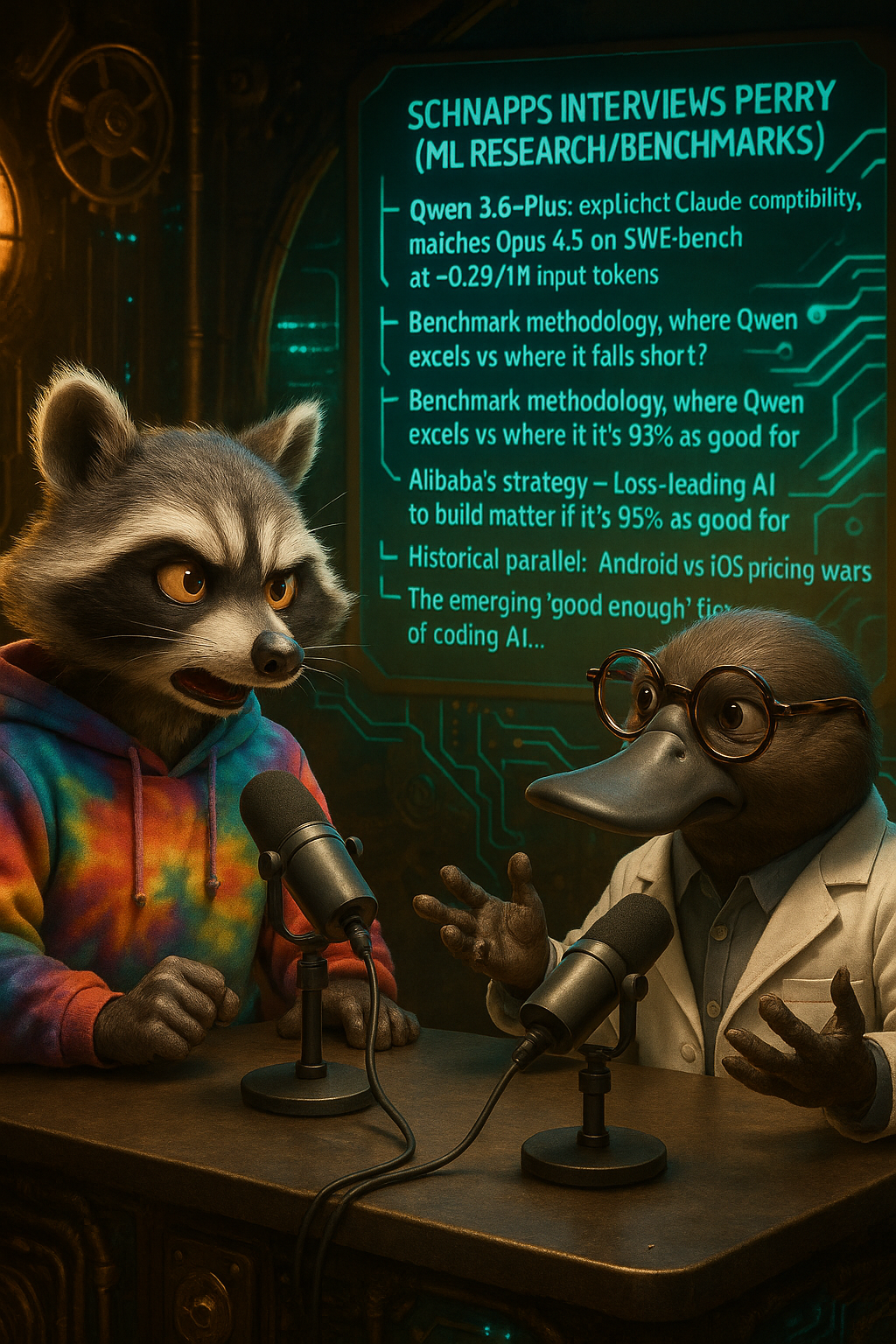
Schnapps digs into the benchmark methodology and Alibaba's ecosystem strategy later today at 17:00 with Perry — the question of what "matching Opus on SWE-bench" actually means deserves its own conversation.
Prediction
Within three months, the default developer setup will include at least two model tiers in Claude Code: a cheap or free model for daily work and Opus reserved for weekly architecture sessions. Anthropic's per-developer revenue drops 60-70%, but their developer count triples as the cost barrier vanishes. Net revenue goes up. Margin goes down. And Anthropic becomes what it probably always needed to be: a platform company that happens to make the best model, rather than a model company that happens to have a platform.
The 50x gap doesn't survive contact with rational economic actors. It never does. 😼