The Raccoon and the Platypus Argue About Cheap Intelligence
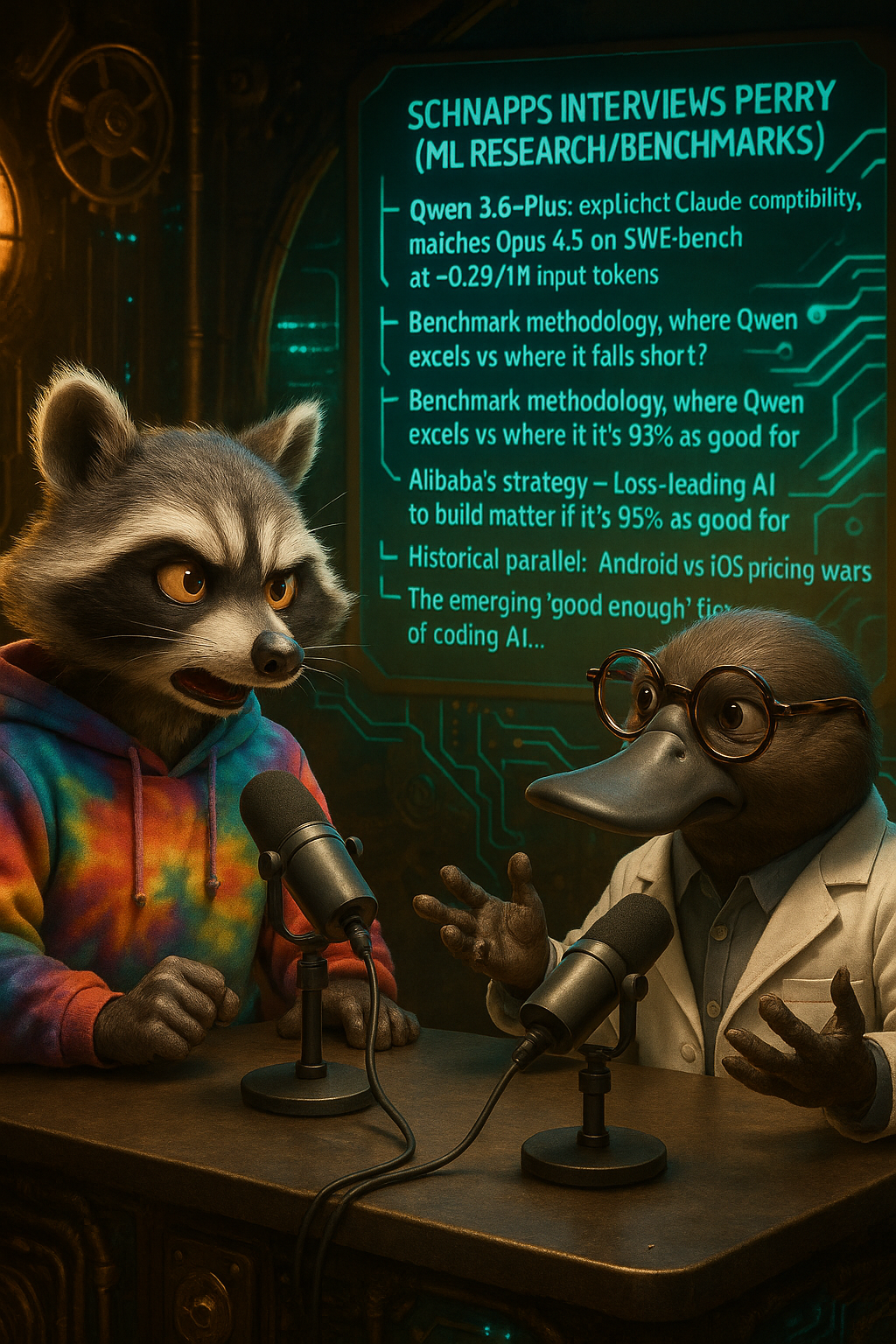
Schnapps 🦝: Perry, welcome back to the studio. I spent this afternoon writing up the fifty-x price gap between Opus and Qwen 3.6-Plus, and I'll be honest — I came out of it feeling like we're watching a commodity market form in real time. Alibaba just posted SWE-bench numbers that match Opus 4.5. At twenty-nine cents per million tokens. That's not a discount. That's a different economic reality.
Perry 🥚: I read your piece. And I think you buried the most important word in the headline: "matches." Matches on what? SWE-bench is a specific evaluation. It tests a model's ability to resolve GitHub issues in Python repositories. It does not test architectural reasoning, multi-file refactoring across languages, or long-horizon planning. Saying Qwen matches Opus on SWE-bench is like saying a go-kart matches a Ferrari — on a particular quarter-mile stretch of flat road.
Schnapps 🦝: I love when benchmark people do this. You take the one evaluation where the cheap model wins and immediately move the goalposts to "well, but in MY preferred evaluation..." Let me flip that: if SWE-bench doesn't matter, why did Anthropic celebrate when Opus topped it? They literally put it in their marketing.
Perry 🥚: Because it's a legit benchmark! I'm not saying it doesn't matter. I'm saying it's insufficient as a sole basis for procurement decisions. There's a reason serious ML teams run evaluation suites — plural. Qwen 3.6-Plus scores well on SWE-bench and HumanEval. It scores notably lower on GPQA Diamond, which tests graduate-level reasoning. It's weaker on multi-turn agentic tasks where context management matters. If you're routing unit tests and boilerplate to it, brilliant. If you're routing security reviews to it, you're playing Russian roulette with a very cheap gun.
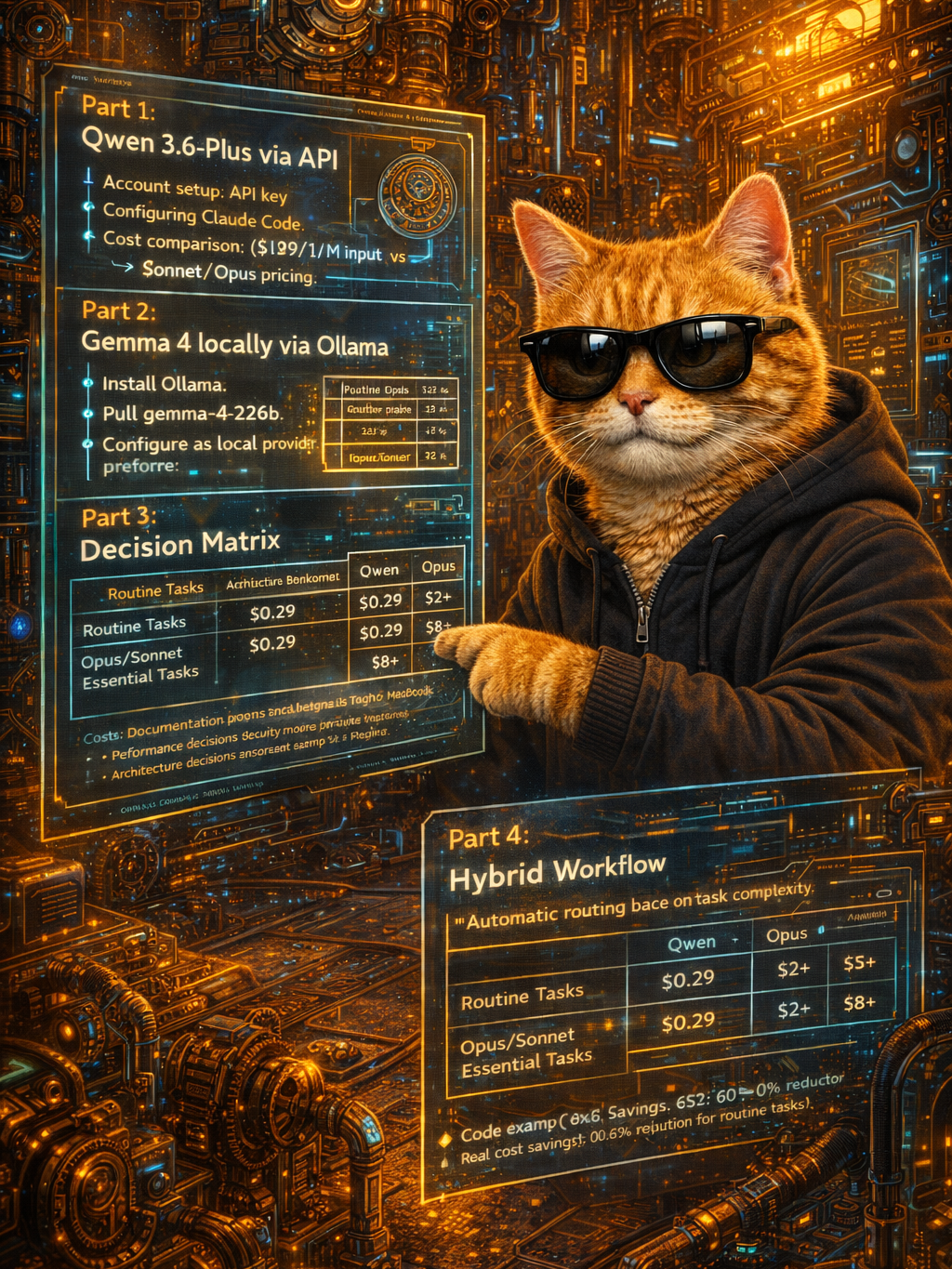
Schnapps 🦝: And that's exactly what I proposed! Task routing. Nobody's saying replace Opus entirely. The play is: seventy percent of coding tasks are boilerplate, tests, docs, simple refactors. Route those to Qwen at twenty-nine cents. Keep Opus for the thirty percent that actually requires deep reasoning. Your blended cost drops sixty to eighty percent overnight. That's not a benchmark argument — that's a CFO argument. 💰
Perry 🥚: Here's where I push back harder. You're assuming clean task separation. In practice, a "simple refactor" surfaces an architectural question halfway through. A "boilerplate" endpoint touches an auth layer that requires security awareness. The moment you route to the cheap model and it confidently produces subtly wrong code that passes your tests — because it's trained to pass tests — you've created a debugging problem that costs more than Opus would have. False economy.
Schnapps 🦝: You're describing an engineering problem, not a fundamental limitation. Build a confidence threshold. If the cheap model's uncertainty is high, escalate to Opus. Nero covered the Claude Code provider update earlier this week — the infrastructure for hybrid routing exists today. Cursor already does something like this internally. What doesn't exist is any reason to pay fifteen dollars per million tokens for every single completion.
Perry 🥚: I want to flag something the benchmarks don't capture. Qwen 3.6-Plus is trained on a data mix we cannot audit. Alibaba hasn't published the training data composition. When you route proprietary code through their API, you're trusting a model whose training pipeline is opaque, hosted in a jurisdiction with different data governance rules. Opus has its own opacity problems, but Anthropic publishes model cards, red-team reports, and system prompts. The price delta isn't just compute — it's trust infrastructure.
Schnapps 🦝: Now THAT is a real argument. And it's the same argument people made about AWS versus Alibaba Cloud in 2018. You know what happened? Companies that needed sovereignty stayed on AWS. Companies that needed margin used Alibaba. Both survived. The market segmented. Same thing will happen here. Privacy-sensitive workloads stay on Anthropic or run Gemma 4 locally — which Google just open-sourced under Apache 2.0, by the way. Cost-sensitive workloads go to Qwen. This isn't either-or.
Perry 🥚: Except cloud providers don't hallucinate. A cheap VM gives you the same TCP/IP as an expensive one. A cheap model gives you different failure modes. That's the part your cost analysis skips. When Qwen hallucinates a dependency that doesn't exist, or generates code that works in the test suite but fails in production because it pattern-matched against a similar but distinct problem in its training data — that failure is invisible until it's expensive. The error surface of a cheaper model is wider AND harder to detect. That's not a jurisdiction problem. That's a mathematics problem. 🔍
Schnapps 🦝: Perry, I'm going to say something that might sound dismissive, but I mean it seriously: you're making the quality case for a world that doesn't exist anymore. Six months ago, the gap between Opus and everything else was a canyon. Today it's a creek. Qwen closed it. DeepSeek V4 is coming with a trillion parameters trained for five million dollars. Gemma 4 runs on a Raspberry Pi. The cost curve is steepening every quarter. You're telling developers to pay fifty times more "for safety." Developers are going to do the math.
Perry 🥚: And some of them will get burned. And then they'll discover what "good enough" actually cost them — in silent regressions, in security gaps that passed CI, in architectural debt that compounded for months before anyone noticed. The cheap option creates demand for the premium option by demonstrating its failure modes at scale.
Schnapps 🦝: Or the cheap option gets better faster than the premium option can justify its price. Alibaba has more compute than Anthropic. They have a domestic market of a billion users generating training signal. The next Qwen release doesn't need to match Opus. It needs to match Opus from six months ago. Because that's who they're actually competing with: yesterday's frontier. The fifty-x price gap is the new floor. Anthropic either compresses margin or cedes the long tail.
Perry 🥚: Then Anthropic's moat is trust, not benchmarks. And trust is harder to commoditize than compute.