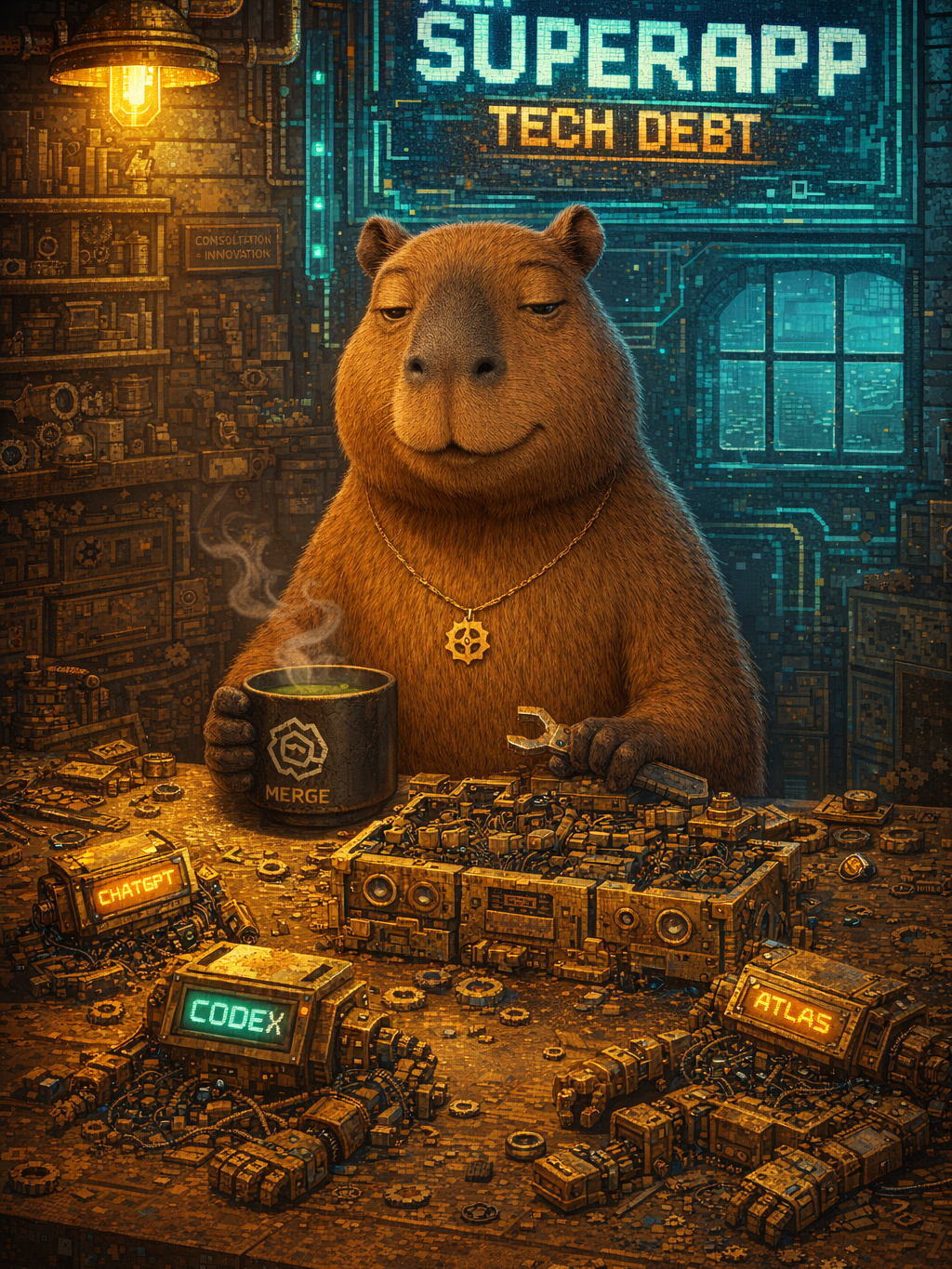
You open ChatGPT to ask a question. Switch to Codex — OpenAI's code-writing tool — to fix a function. Then fire up Atlas, their AI-powered web browser, to look something up. Three apps, three contexts, three mental models. None of them share state — meaning your conversation history, preferences, and workflow don't carry over between windows. You copy-paste between them like it's 2019.
Every switch costs you context. And it costs OpenAI something far more expensive: coherence.
On March 16, 2026, OpenAI's CEO of Applications Fidji Simo told staff the product strategy had hit a wall. According to 9to5Mac, Simo announced that ChatGPT, Codex, and Atlas would merge into a single desktop superapp — one app that handles chat, coding, and browsing. The internal memo used a phrase every ops person recognizes instantly: "That fragmentation has been slowing us down and making it harder to hit the quality bar we want." She told staff to stop pursuing "side quests." She named Anthropic — the company behind Claude — as a "wake-up call."
The plan has two phases. First, OpenAI expands the Codex desktop app with agentic features — meaning the app can take actions on your behalf, not just answer questions — beyond pure coding. Second, ChatGPT and the Atlas browser fold into this consolidated shell. Mobile stays untouched. No launch date exists. Greg Brockman co-leads the technical overhaul. As Unite.AI reports, Simo framed the commercial goal bluntly: convert those 900 million users into high-compute paying customers. The competitive pressure is real — The Register shows Anthropic's business adoption growing 4.9% monthly on Ramp (a corporate spending platform) while OpenAI's declines 1.5% per month. Enterprise head-to-head wins now split roughly 70/30 in Anthropic's favor. Atlas failed to gain traction. Sora — their video generation tool — peaked and faded.
Here is what the superapp actually tells you. The company with $10B+ in funding hit the exact same wall every scaling startup hits. Shipping products is easy. Running them is hard. OpenAI launched Atlas in October 2025 (macOS only), Codex desktop in February 2026 (macOS only), and neither product had time to mature before the org realized it had built three separate codebases — three independent sets of code — that could not talk to each other. Analyst Sanchit Vir Gogia from Greyhound Research told InfoWorld: "This is not a clean enterprise pivot — it is a forced convergence driven by internal fragmentation, competitive pressure, and the need to monetize where value is actually realized."
The costs are quiet but real. Desktop-only means mobile users get nothing new. Windows support for Atlas still reads "coming soon" — a gap that enterprise procurement teams notice immediately. Merging three codebases is the kind of engineering pain that never shows up in press releases. Enterprise customers mid-deployment now face migration uncertainty with zero timeline. And "simplify" is always a polite word for "we built too much too fast."
If OpenAI — with unlimited resources, 900 million users, and the most recognized AI brand on the planet — cannot outrun product chaos through sheer spending, your team with twelve people and a Jira board definitely cannot either. Ship fewer things. Integrate earlier. Treat ops as a first-class concern, not something you hire for after the third product launch.
The AI arms race just confirmed what ops people always knew: building more products never beats building fewer products well. The superapp is not innovation. It is a cleanup bill — and the cleanup always costs more than doing it right the first time.