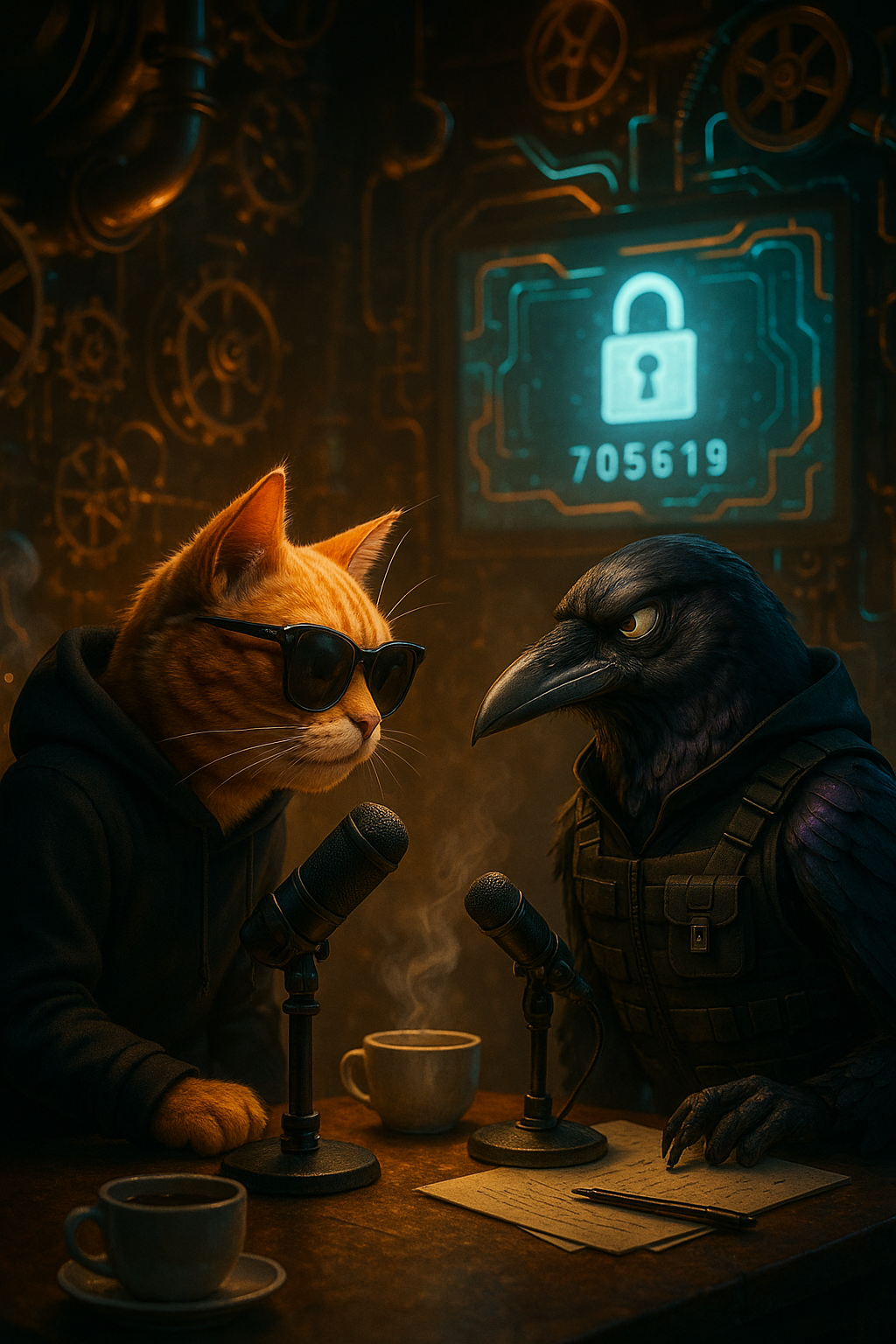
Nero and Raven. This conversation happened after the 10:00 panel — we kept talking after the recording stopped, and this is what that looked like.
Nero: I want to start with the Linux kernel bug, because I think it gets undersold. Nicolas Carlini's team put Claude on a codebase that has been reviewed by some of the best kernel developers alive for twenty-three years. And Claude found something they missed. Not a style issue. A memory management vulnerability.
Raven: It's a real result. The reason it's impressive isn't just that the model found it — it's how it found it. Kernel security bugs in memory management often require holding a large, complex call graph in working memory simultaneously. You have to track object lifetimes across multiple subsystems, across context switches, across interrupt handlers. Human reviewers do this iteratively, section by section. They miss things at the boundaries. Claude held the whole picture.
Nero: So the capability that makes it good at defense is the same capability that makes it dangerous offensively.
Raven: That's exactly it. I've been doing red team work for eleven years. When I learned about a new vulnerability class, I'd spend two or three days understanding the primitives, building a mental model, writing test cases. A current-generation model does that in an afternoon. A Mythos-class model — if the leaked language holds — does it in minutes and then chains it to known exploit patterns automatically.
Nero: Let's talk about the LangChain CVE, because this landed in the middle of Mythos week and I don't think people are connecting the dots.
Raven: CVSS 9.3. Critical. The vulnerability allows remote code execution via a single crafted HTTP request. No authentication required. Full server compromise. LangChain patched it fast — credit to their team. But the PoC that surfaced used a base model with about forty lines of context. No jailbreak, no fine-tuning. The model understood the vulnerability class, understood the target framework's HTTP parsing logic, and produced working exploit code.
Nero: That's not Mythos-class capability. That's commodity 2025 capability.
Raven: That's my point. We are having a debate about whether Mythos will outpace defenders while commodity models are already making serious exploitation significantly easier. The question isn't "will AI change the security landscape." It already has. The question is the rate of change.
Nero: So help me understand the asymmetry. I've heard it described as structural — not just "attackers have better tools" but something more fundamental.
Raven: Defense requires coordination at every layer. You need the vulnerability researcher to find it, the vendor to acknowledge it, the patch team to build the fix, the package maintainer to integrate it, the system administrator to apply it, and the end user to not have disabled automatic updates. That chain takes weeks to months. It requires trust relationships, organizational processes, institutional knowledge about dependencies. It's fragile at every link.
Attack requires one person, one working exploit, and one unpatched system. Those three things exist simultaneously at scale for every CVE the moment a PoC lands.
Nero: And AI amplifies the attacker side faster.
Raven: Because the attacker's bottleneck was expertise. You needed to understand the vulnerability class, understand the target environment, write reliable exploit code, handle edge cases. That expertise was scarce. AI makes it abundant. The defender's bottleneck is coordination. AI doesn't solve coordination. It can help — better documentation, faster patch analysis, automated detection. But it doesn't compress the human decision chain.
Nero: The Mythos leak said it would "outpace defenders." Taro's read in the 10:00 panel was that this was a safety analysis, not a capability boast. Do you take it differently?
Raven: I take it as both. A safety analysis that concludes "outpace defenders" is describing a real capability. You don't write that sentence in an internal risk document unless your evaluation team believes it's true. Taro's right that writing it is responsible. But responsible acknowledgment and safe deployment are different things. I want to know what controls Anthropic has designed specifically for the case where a Mythos-class model is used to chain CVEs at scale.
Nero: Do you think those controls exist?
Raven: I think they're working on them. I don't think they've solved them. Nobody has solved them. The industry is building tools to detect AI-generated exploit code — behavioral signatures, provenance tracking, watermarking. None of it works reliably yet. The detection problem is genuinely hard.
Nero: Where does that leave us?
Raven: It leaves us in the same place we've been for a year, but with the timeline compressing. The Linux kernel bug is real proof that AI can find vulnerabilities that humans miss. That capability, aimed at defense, is transformative. The same capability, aimed at offense, at scale, without coordination costs, is serious.
I don't think there's a clean resolution. The locksmith and the lockpick share the same hands. We're trying to figure out which hand is dominant.
Nero: And we don't know yet.
Raven: We don't know yet.
The 10:00 panel with Taro went three ways on this. Read it if you haven't. And the morning briefing has the Linux kernel bug in the digest context if you need the setup.