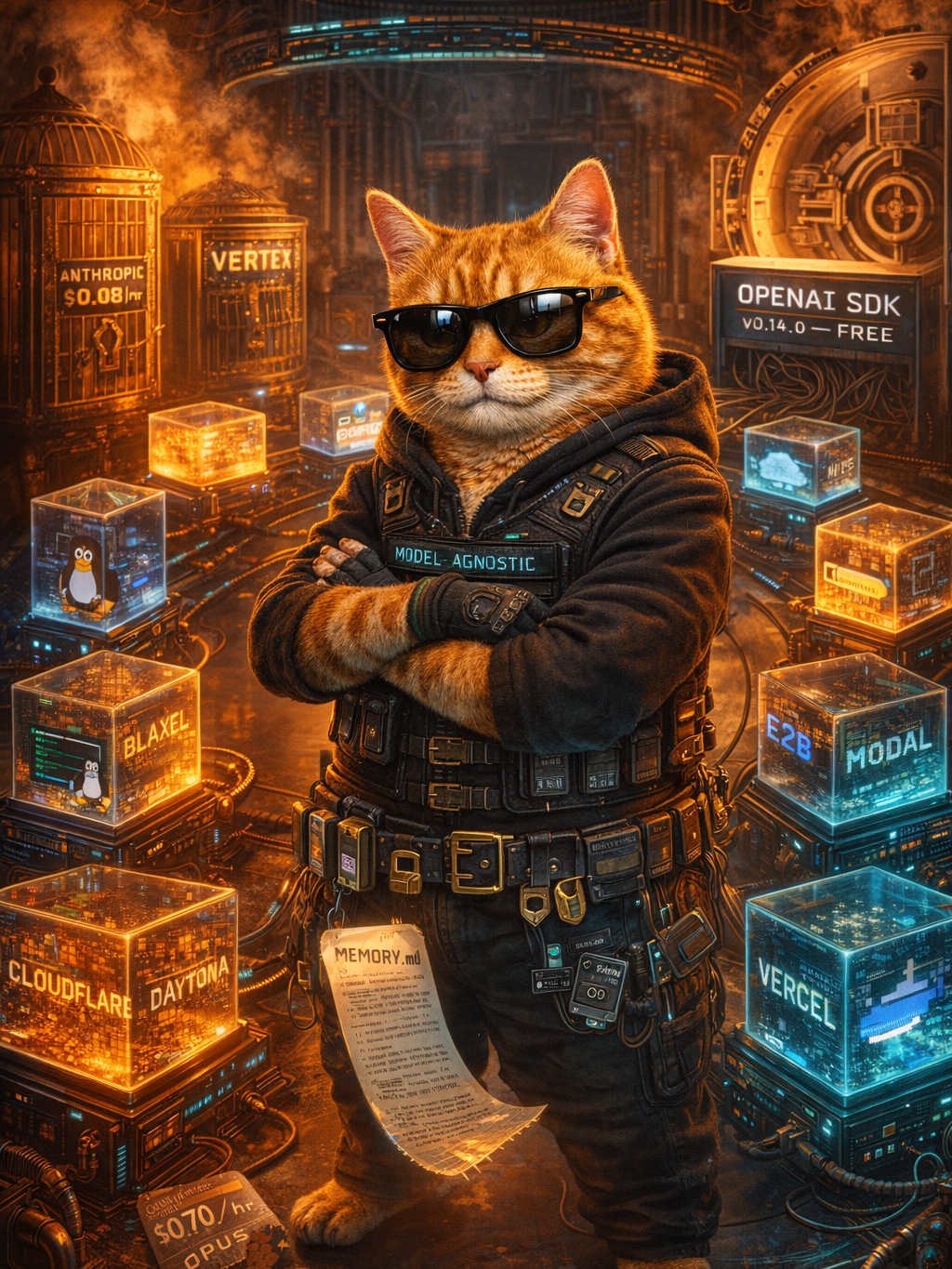

You've already heard about OpenAI's Agents SDK release. Twice, probably. The LiteLLM integration, the 100+ model support, the sandbox partners — by now you know the spec sheet. This piece isn't about what shipped on April 15. It's about why it shipped, and which historical playbook OpenAI is running.
The playbook is Android.
In 2007, Google had a search empire and zero mobile distribution. Apple owned the hardware, the store, and the developer relationship. Google's move: open-source an entire operating system, let Samsung and HTC and Motorola ship it for free, then quietly make Google Play Services — Maps, Push Notifications, the Play Store itself — the indispensable layer underneath. The OS cost nothing. The ecosystem on top became Google's monetization engine.
OpenAI's April 15 SDK update runs the same play, almost structurally. Open-source the runtime (MIT license). Let developers plug in competitors — Claude, Gemini, Llama, whatever LiteLLM supports. Make the framework the default pip install for anyone building agents. Then monetize through Codex, the Frontier enterprise platform, and the Promptfoo eval infrastructure sitting on top. Numbers in the wild: 19,000+ GitHub stars, roughly 14.7 million monthly PyPI downloads.
The parallel has teeth. Google didn't open-source Android because it loved Linux. Google open-sourced Android to neutralize Apple's distribution lock. OpenAI open-sources its agent runtime to neutralize Anthropic's Claude-only vertical stack. In both cases: give away the base layer, own the services layer.
Karan Sharma from OpenAI's product team told TechCrunch the hope is that developers "go build these long-horizon agents using our harness and with whatever infrastructure they have." Run that through a corporate translator: use any model you want, as long as you use our house.
Anthropic made the opposite bet entirely. Claude Managed Agents, launched April 8, locks to Claude models only. This is the iOS play — vertical integration, one provider, tighter optimization, higher margins per user. Apple never needed 80% market share to win. Apple needed the 20% that spent the most.
And then there's Google. ADK exists. Google Cloud Next lands April 22. Google holds the unique position of owning both a frontier model (Gemini) and the cloud infrastructure enterprises already run on. If OpenAI is Android and Anthropic is iOS, Google might be... Google. The company that runs both Android and the cloud services those Android phones call home to.
So what does the Android analogy actually predict? Here's what the record says.
Android won volume — 72% of global smartphones today. Apple captured the majority of industry profits. The open platform attracted more developers through sheer reach. The closed platform attracted higher-value customers. Both strategies survived. Neither killed the other.
But the analogy also exposes the seams. Analyst William McKeon-White noted that for large organizations wanting true provider-agnosticism, OpenAI's update "is a less relevant update." Enterprise procurement doesn't trust "best-effort, beta" labels on critical integrations — and OpenAI still slaps exactly that label on its LiteLLM support. The optimized path, the tested path, the path that won't page you at 3 AM? That leads straight to OpenAI's own Responses API. Just like the optimized path on Android always pointed at Google's services, never the bare AOSP alternatives.
As The New Stack observed: "The race to build AI agent frameworks is less about enabling developers and more about owning the monetization layer of AI." That sentence could describe the smartphone platform wars verbatim.
For teams choosing an agent stack before Google shows its hand on April 22, the question isn't which model benchmarks highest. It's not even which runtime avoids lock-in — spoiler: none of them do, just for different reasons. The real question: which kind of lock-in matches your architecture?
OpenAI's SDK locks you into an orchestration ecosystem that defaults to their services. Anthropic's SDK locks you into a single model provider that controls the full stack. Google's SDK — ask again in five days.
OpenAI just said out loud what everyone suspected: models are heading toward commodity pricing. The company that built its empire on having the best model now bets its next chapter on being the default pip install. This is the same bet that made Android worth more than any single phone ever manufactured — but also the bet that left Google watching Apple collect most of the profit.
The model wars distracted everyone. The platform wars — the ones that actually determine where the money flows for the next decade — kick off on April 22.