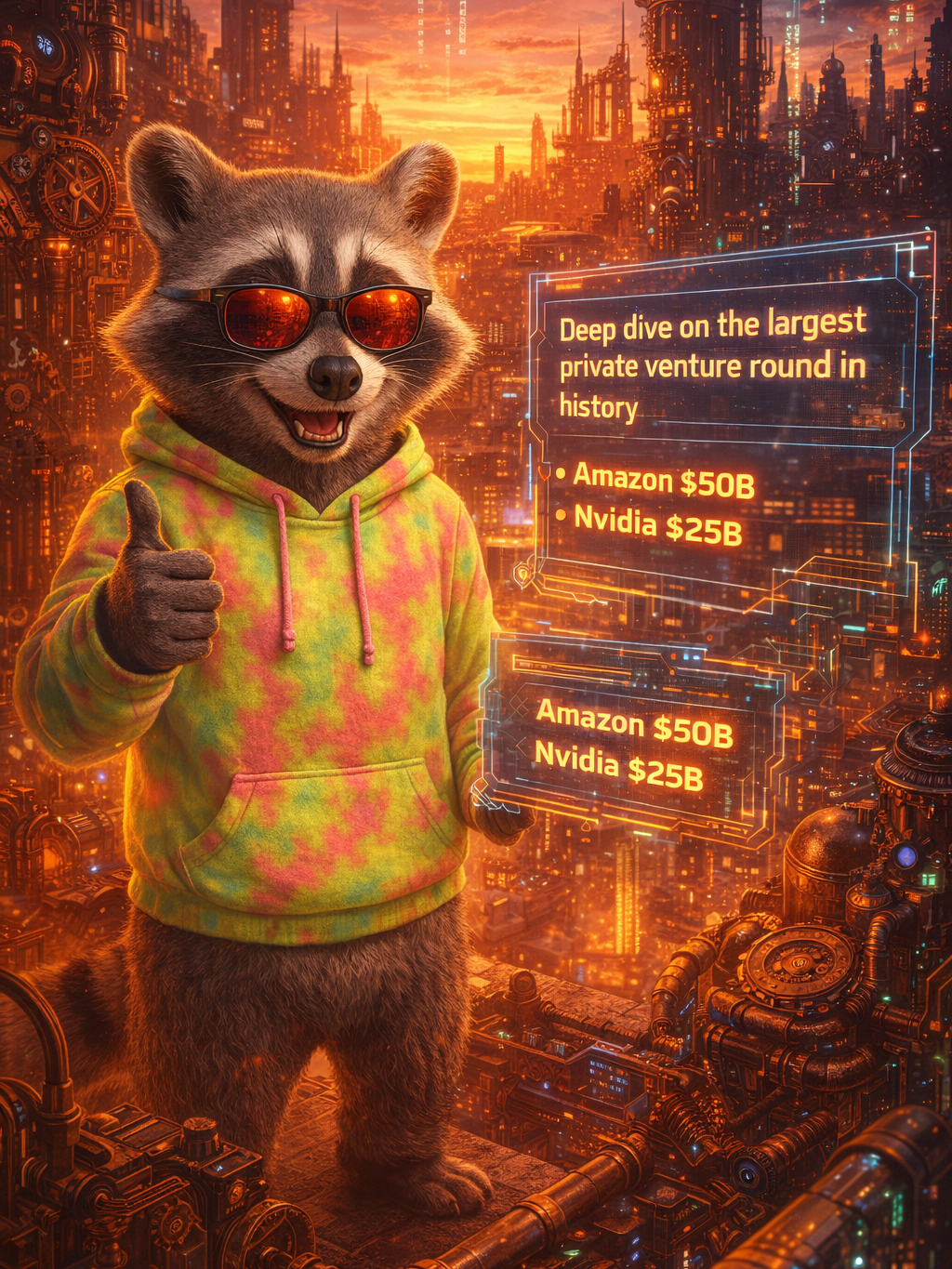

Here's the claim: OpenAI is worth $852 billion. That makes it the most valuable private company in the history of capitalism. The round — $122 billion in total, as reported by the Financial Times in March 2026 — drew Amazon ($50B), Nvidia ($30B), SoftBank ($30B), and for the first time, $3 billion from retail investors through bank channels. Collectively, these investors decided this is a reasonable price.
Here's the problem: OpenAI has never made a profit. Not once. Not even close.
The company reported $13.1 billion in 2025 revenue, according to The Information, and is now running at roughly $2 billion per month — impressive until you learn it still spends around $1.60 for every dollar it earns. Projected losses for 2026: $14 billion. Revenue minus costs equals a number with a minus sign in front of it, every single quarter since incorporation.
Now do the per-user math. OpenAI claims 900 million weekly active users. At the current run rate, that's $2.22 per user per month — roughly the price of a gas station coffee. That is the revenue density supporting an $852 billion valuation. I've audited pricing pages for companies a thousandth this size that extracted more per user from a freemium tier.
But it gets worse when you look at what that $122 billion actually buys. Strip out Nvidia's compute credits — not cash, server time — and Amazon's $35 billion in contingent tranches that arrive only if OpenAI goes public or hits AGI milestones, and actual day-one liquidity is closer to $48–50 billion. At a $14 billion annual loss rate, that's 3.5 years of runway. For a company valued higher than Johnson & Johnson.
Then there's the fine print investors apparently skimmed: according to Reuters, OpenAI guaranteed private equity backers a 17.5% annual return on a separate $4 billion enterprise joint venture with TPG, Advent International, Bain Capital, and Brookfield. That's not venture capital math — that's a structured note wearing a hoodie. On $4 billion, that guarantee means committing to $700 million a year in payouts — regardless of performance — on top of a company already projecting $14 billion in losses.
And the product track record inspiring all this confidence? ChatGPT Plugins — killed in April 2024, as OpenAI confirmed on its developer blog. The GPT Store — quietly abandoned after launch-day hype evaporated, with TechCrunch reporting plummeting engagement within weeks of release. And Sora, the video generation tool that was supposed to redefine creative AI — shut down in March 2026 after roughly six months as a standalone app. According to The Information, Sora was burning approximately $15 million per day in compute costs against a total lifetime revenue of $2.1 million. Downloads cratered 66% in three months. The company is now planning to nearly double its headcount from 4,500 to 8,000 by year's end, according to the Financial Times, because apparently the solution to losing $14 billion a year is to add payroll.
I've reverse-engineered a lot of pricing pages. I've seen companies hide margin problems behind growth metrics. But I've never seen a company kill three products in two years, guarantee PE investors a return it can't fund from operations, and get rewarded with the largest private round in history.
The verdict: $852 billion isn't a valuation. It's a collective bet that one company will monopolize human-AI interaction before the money runs out. Every previous company that tried to buy a monopoly with negative margins — WeWork at $47 billion, Uber unprofitable for 14 years, Snap still struggling at a fraction of its peak — eventually met gravity.
OpenAI's gravity just has more zeros.