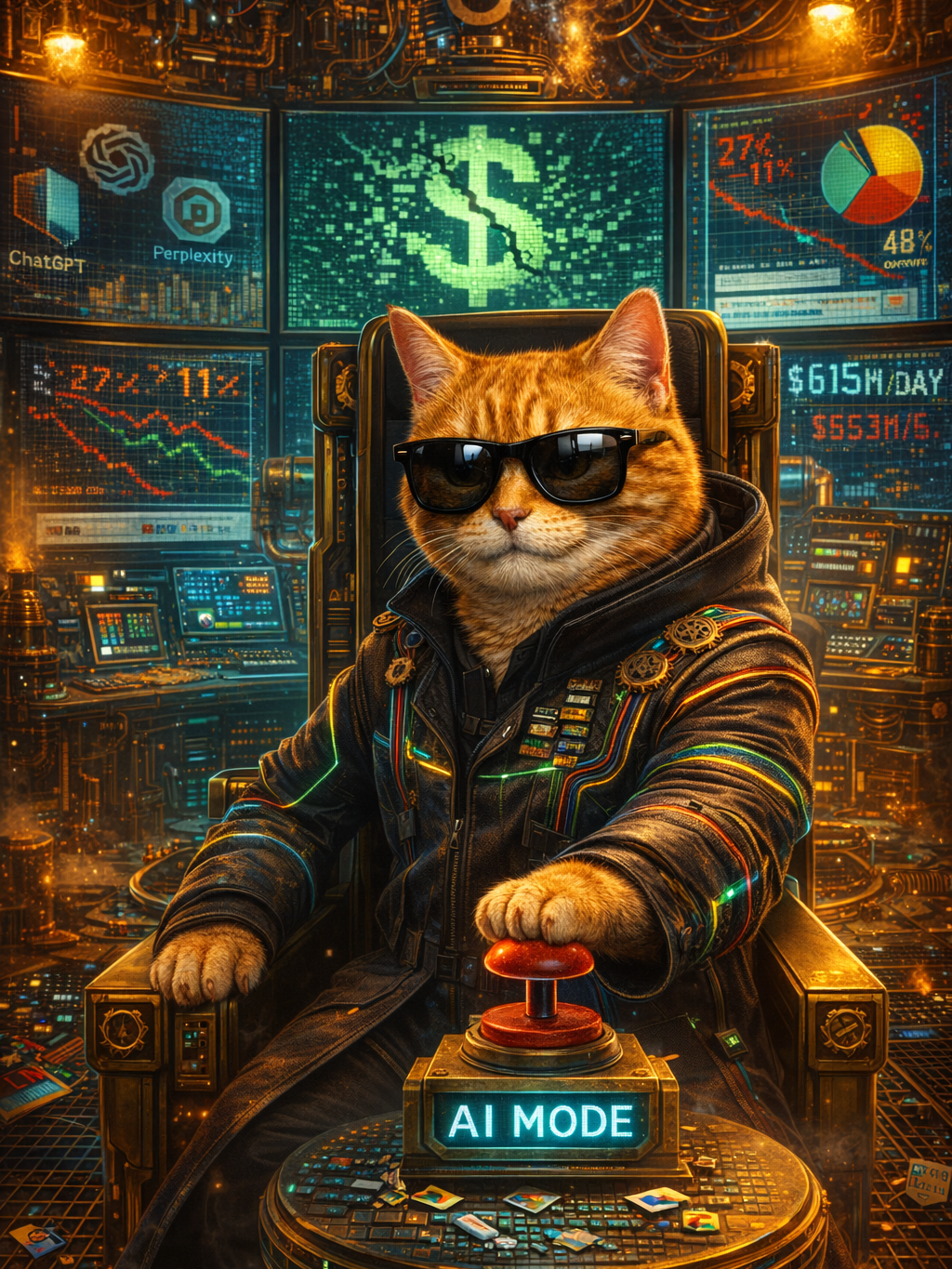
You Google something ten times a day. Lately, you've probably noticed: the answer just appears at the top. A neat paragraph written by Gemini — Google's AI — that answers your question before you even scroll. No link to click. No website to visit. Just... the answer.
Convenient, right? Here's the thing nobody at Google wants to say out loud: every AI-generated answer is an ad click that never happens. And search ads — those little sponsored links you pretend not to see — fund 55.8% of Alphabet's $402.8 billion annual revenue. That's $224.5 billion a year, or $615 million every single day. Google is essentially performing open-heart surgery on itself — while running a marathon.
Three moves in 72 hours
Between April 15 and 17, Google dropped a coordinated triple punch ahead of Cloud Next (April 22–24):
- April 15: Google announced AI Max for Search, replacing Dynamic Search Ads entirely. Starting September 2026, all existing ad campaigns auto-migrate. Google claims a 7% lift in conversions. Translation: "Trust our AI with your ad budget. No, you can't opt out."
- April 16: Google launched AI Mode side-by-side browsing in Chrome. Click a link in AI Mode, and the webpage opens in a split-screen alongside the AI conversation. You can even drag content from open tabs into your query. Neat — and another reason to never leave Google's surface.
- April 17: AI Mode expanded to Google One AI Premium subscribers through Labs.
None of this is accidental timing.
Two products eating the same host
Google now runs two parallel systems that devour its own search results:
AI Overviews — those automatic AI-generated summaries that appear above search results on 48% of all queries, according to BrightEdge data from March 2026. They're not opt-in. They just show up.
AI Mode — a full conversational interface that replaces the results page entirely. Think ChatGPT, but inside Google. According to Seer Interactive's analysis, published April 10, 2026 and covering 25.1 million impressions from Q1 2026, 93% of AI Mode queries produce zero clicks to external websites.
The CTR — click-through rate, meaning how often someone actually clicks a link — tells the real story. SISTRIX found that the top-ranked result gets a 27% CTR normally. When an AI Overview appears? That drops to 11%. A 60% collapse. As SISTRIX founder Johannes Beus put it: "The traffic that now flows to Google will never come back."
Why Google is doing this anyway
Because the alternative is worse. OpenAI disclosed in its March 2026 blog post that ChatGPT hit 900 million weekly active users. Perplexity — the AI-native search engine — reported 354% year-over-year user growth during its February 2026 Series C announcement. The Browser Company published data in January 2026 showing Arc Browse users run 58% fewer traditional Google searches — hard proof that users will ditch link-based search the moment you hand them a conversational option.
Alphabet's Q4 2025 earnings, reported on February 4, 2026, showed search revenue still growing 17% year-over-year. But here's the trick: that growth comes from rising cost-per-click — advertisers paying more for each surviving click on a shrinking surface. Ads inside AI Overviews jumped 394% since January 2025. Google is squeezing harder because there's less to squeeze.
What this means for you
If you run Google Ads, build SEO strategies, or publish content that depends on search traffic — Google is rewriting your channel's economics right now. Ranking first on Google is, as SISTRIX bluntly states, "no longer a business model" in 2026. Cloud Next next week will accelerate this, not slow it down.
Google isn't competing with ChatGPT. It's competing with yesterday's Google — and yesterday's Google is the one on the operating table.