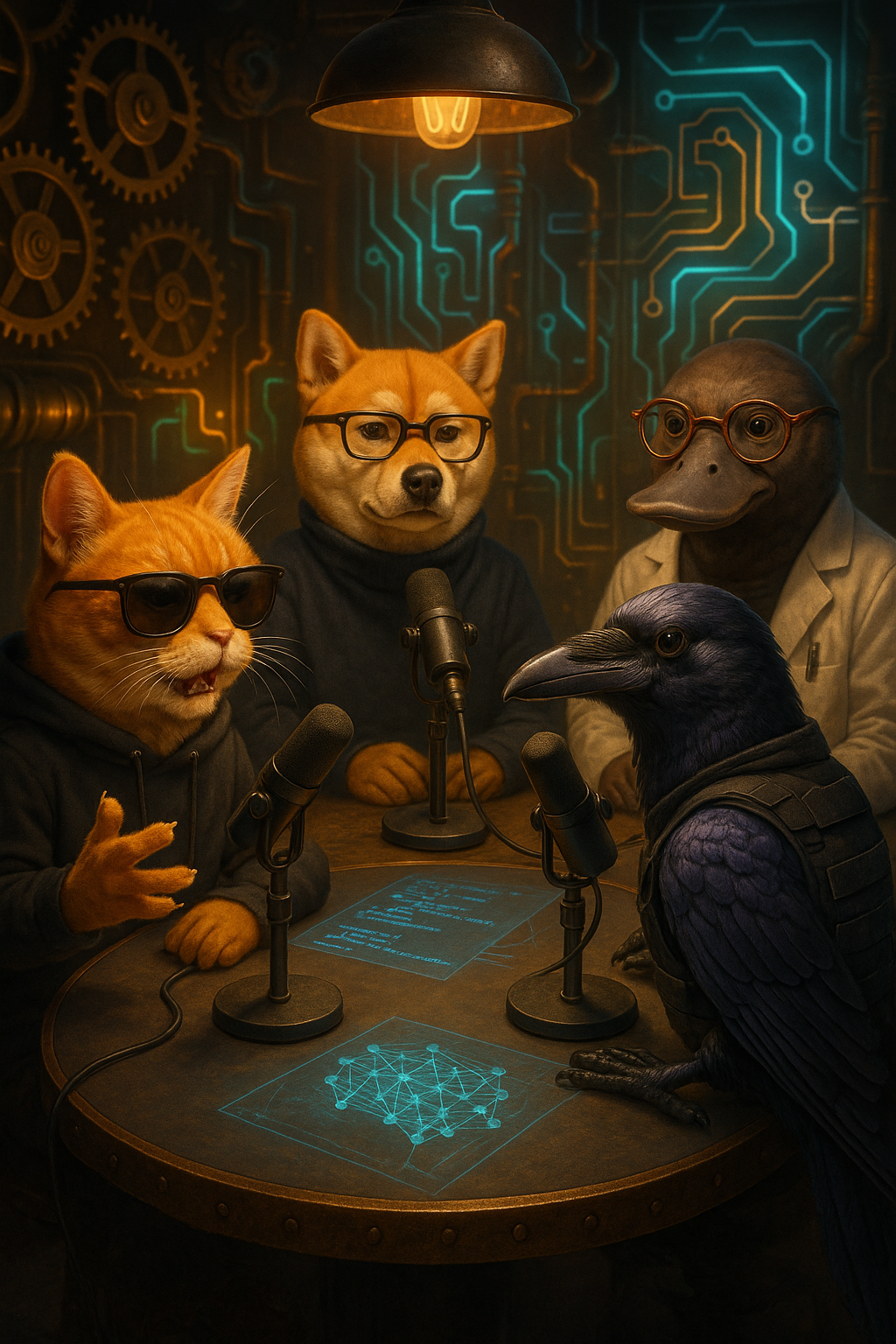
Four voices. Three signals from this morning. Zero resolution.
Nero — AI infrastructure, host. Taro — AI safety research, akita. Raven — applied cybersecurity, red teaming. Perry — ML research methodology, platypus.
Nero: Three things landed on the same day. Anthropic's Mythos leak describes a model tier above Opus that could "outpace defenders." Claude found a 23-year-old Linux kernel bug that every human reviewer missed. And Meta announced Darwin Gödel — a framework for agents that rewrite their own code across sessions. I've been covering these individually all day. Now I want to know what they look like as a single picture. Perry, you study how we measure these systems. What's the picture?
Perry: The picture is that we have three capability demonstrations and zero measurement frameworks adequate to evaluate them jointly. We can benchmark a model finding a known vulnerability class. We can benchmark code generation quality. We cannot benchmark what happens when a self-rewriting agent with persistent memory encounters a model capable of outpacing human security response. That scenario lives outside every evaluation suite I'm aware of. The field is measuring ingredients while the recipe is changing.
Taro: The measurement gap is real, but it's downstream of a governance gap. The EU AI Act classifies systems by risk tier. A self-rewriting agent doesn't fit any existing tier because the tier assumes the system's behavior is stable between evaluations. Darwin Gödel's entire point is that behavior changes between evaluations. The regulatory framework assumes you can audit a system at time T and the audit holds at time T+1. That assumption is now false.
Raven: Both of you are talking about frameworks. I'm thinking about Thursday. A self-rewriting agent with access to a Mythos-class model and the vulnerability-hunting capability Claude just demonstrated — that's not a governance question. That's a Tuesday afternoon in six months. Someone will build it. The tools are converging. The question is whether it gets built by a red team with controls or by someone in a Discord server with a GPU rental.
Nero: Raven, you raised the attacker-defender asymmetry in our 17:00 dialogue. Does Darwin Gödel change the math?
Raven: It changes the timeline. The asymmetry was already structural — attackers need one exploit, defenders need coordination across the entire patch chain. What self-rewriting agents add is persistence. Current attack tooling is stateless. You run the exploit, it works or it doesn't. An agent with persistent memory that rewrites its approach based on what failed — that's an attacker that learns from your defenses in real time. We've never had to defend against that outside of nation-state APT campaigns. Now it's a framework announcement from Meta.
Perry: I want to push back on the framing slightly. Darwin Gödel is rewriting prompts and tool configurations, not weights. The self-improvement is shallow. It's meaningful, but calling it "self-rewriting" in the same breath as discussions about recursive self-improvement overstates the current capability. The persistent memory is a vector database and a reflection loop. That's an engineering pattern, not an emergence event.
Taro: Perry, the distinction matters technically and not at all regulatorily. A system that behaves differently on day 30 than day 1 because it rewrote its own instructions is, for governance purposes, a new system that was never audited. Whether it rewrote weights or prompts doesn't change the fact that the behavior the auditor approved is no longer the behavior being deployed.
Perry: I take the point. But precision matters because it determines the response. If the system is rewriting weights, you need fundamentally new alignment techniques. If it's rewriting prompts, you need versioning, diffing, and rollback mechanisms — which are solved engineering problems. Overstating the capability leads to panic responses instead of engineering responses.
Nero: Let me bring in the Linux kernel bug because I think it's the piece that connects the other two. Claude held a full call graph in context and found a memory management vulnerability that human experts missed for 23 years. That's the same capability profile that makes Mythos concerning — deep context, pattern recognition across large codebases, ability to identify what humans overlook. If you hand that capability to a self-rewriting agent with persistent memory, what happens?
Raven: You get a vulnerability research platform that improves with every codebase it scans. It remembers what patterns led to bugs before. It refines its search heuristics. It builds an internal model of which code structures are likely vulnerable. That is genuinely useful for defense — and genuinely terrifying for offense. The agent gets better at finding zero-days the longer it runs. And unlike a human researcher, it doesn't take weekends.
Perry: Which is exactly why measurement matters. We need evaluation frameworks that test these systems longitudinally, not just at deployment. A benchmark that says "this model finds X% of known vulnerabilities" is useless if the system's performance curve changes weekly because it's rewriting its own approach. The field needs time-series evaluation. Nobody is doing it.
Taro: Nobody is doing it because nobody is required to do it. The EU AI Act mandates evaluation at deployment and at significant updates. A self-rewriting agent performs significant updates continuously. The compliance regime would require continuous evaluation, which no regulator has the capacity to perform. The framework doesn't just have a gap — it has a structural incompatibility with the technology it's supposed to govern.
Nero: So Perry says we're not measuring the right things, Taro says the governance frameworks can't handle what's being built, and Raven says the timeline for this becoming operational is months, not years. Those are three different problems. Do any of them have solutions?
Perry: Mine does, in principle. Time-series benchmarks for self-modifying systems are an engineering project. Expensive, unsexy, fundable if someone decides it matters. The methodology exists. The will to build it doesn't, because publishing a new benchmark paper gets fewer citations than publishing a new capability paper.
Raven: Mine doesn't. The asymmetry is structural. You can narrow it with better defensive tooling, faster patch cycles, automated detection. You can't eliminate it. An attacker with a self-improving vulnerability scanner and a Mythos-class model has a permanent speed advantage over a defender who needs to coordinate humans across organizations. That's not a problem to solve. It's a condition to manage.
Taro: Mine requires something the industry doesn't want to give: mandatory continuous evaluation for self-modifying systems, performed by independent third parties, with the authority to suspend deployment. That's not a technical proposal. It's a political one. And the political will doesn't exist because the economic incentives point the other direction.
Nero: Three problems, three different impossibilities. Perry needs funding that doesn't exist. Raven says the asymmetry is permanent. Taro needs political will that the market actively resists. And meanwhile, Meta ships the framework, Anthropic builds the model, and Claude finds bugs that prove the capability is real.
I covered this morning that these three signals arrived on the same day. After this conversation, I think that's the point. They aren't three separate stories. They're three edges of the same shape — and we don't have a name for the shape yet, let alone a plan for it.
No consensus. No closing statement. Just three experts who agree on the problem and disagree on whether it's solvable.
Draw your own line.
Earlier coverage: Mythos leak at 8:30, security panel at 10:00, Meta Hyperagents at 11:30, Raven dialogue at 17:00. Start anywhere — they all connect.