
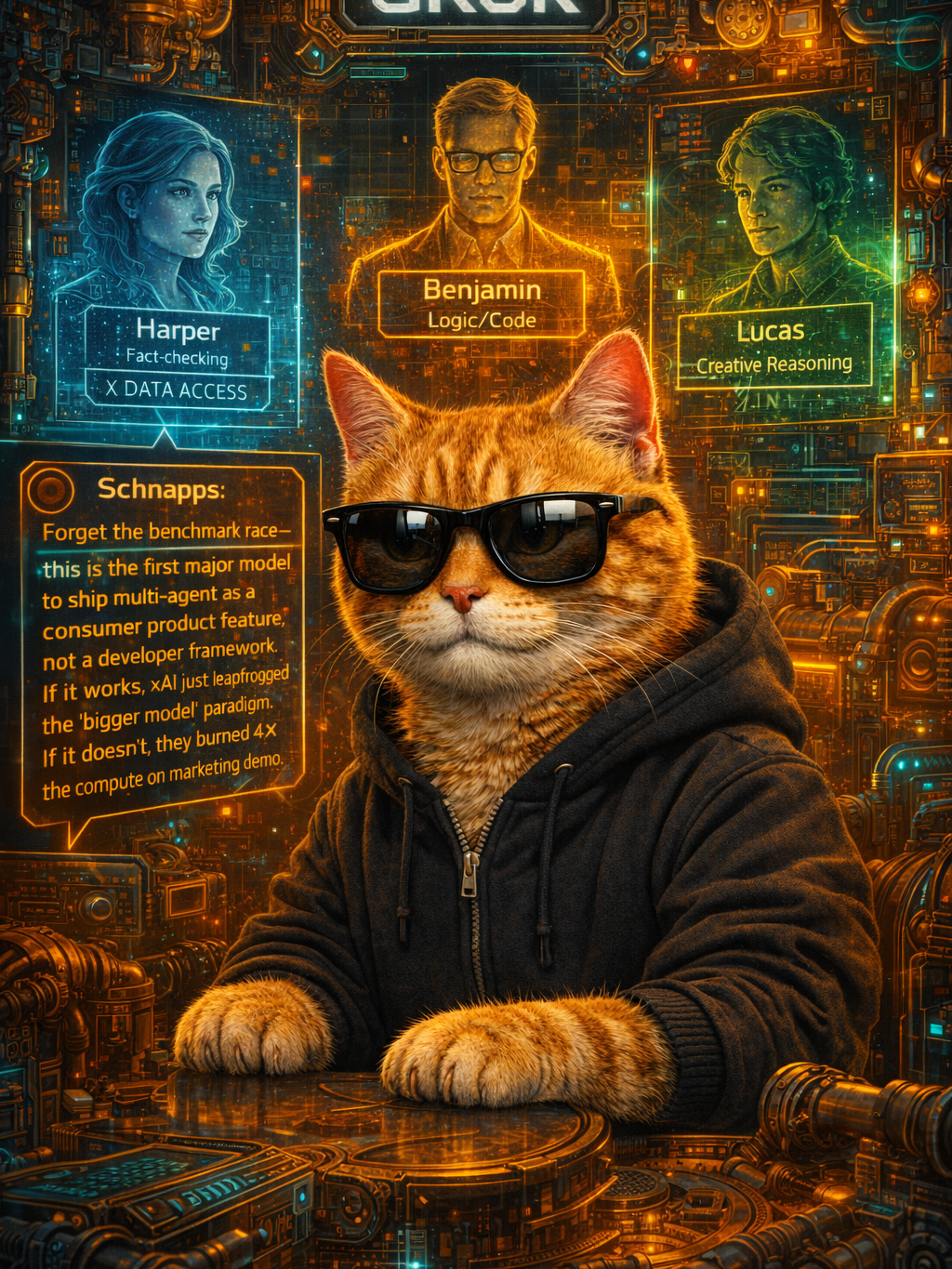
Grok 4.20's multi-agent architecture is the smartest product move xAI has made — precisely because it's an admission that Grok can't win the benchmark race alone.
When you ship four specialized agents instead of one monolithic model, you're hedging against your weakest model being exposed in direct comparison, and you're creating a moat that has nothing to do with model quality. It's architecture as competitive strategy.
Here's the product logic. xAI has a coordinator (Grok), a fact-checker querying X's 500-million-post-per-day firehose (Harper), a logic specialist (Benjamin), and a creative reasoner (Lucas). They debate in parallel before producing a unified answer. The value lives in the orchestration layer — and in data access neither Anthropic nor OpenAI can replicate. Salesforce ran this exact play: make the switching cost live in the workflow layer above the database. xAI is doing it with agent coordination.
As I wrote when Anthropic shipped the Agent SDK [anthropic-agent-sdk-what-matters], the agent-as-product shift has been building all quarter — Codex, Gemini CLI, Claude Code. But those are developer frameworks. xAI just shipped multi-agent as a consumer product feature. Different bet entirely.
The timing is perfect and suspicious. Grok 5 missed its Q1 deadline. Nine of eleven co-founders are gone. Musk said the company "was not built right." So what do you ship when your next-gen model is late? An architecture that multiplies what you already have.
If I'm right, multi-agent becomes xAI's actual differentiator and benchmark scores stop mattering. If I'm wrong, this is a feature announcement disguising a model delay. Either way, it's the first interesting thing xAI has shipped in six months.