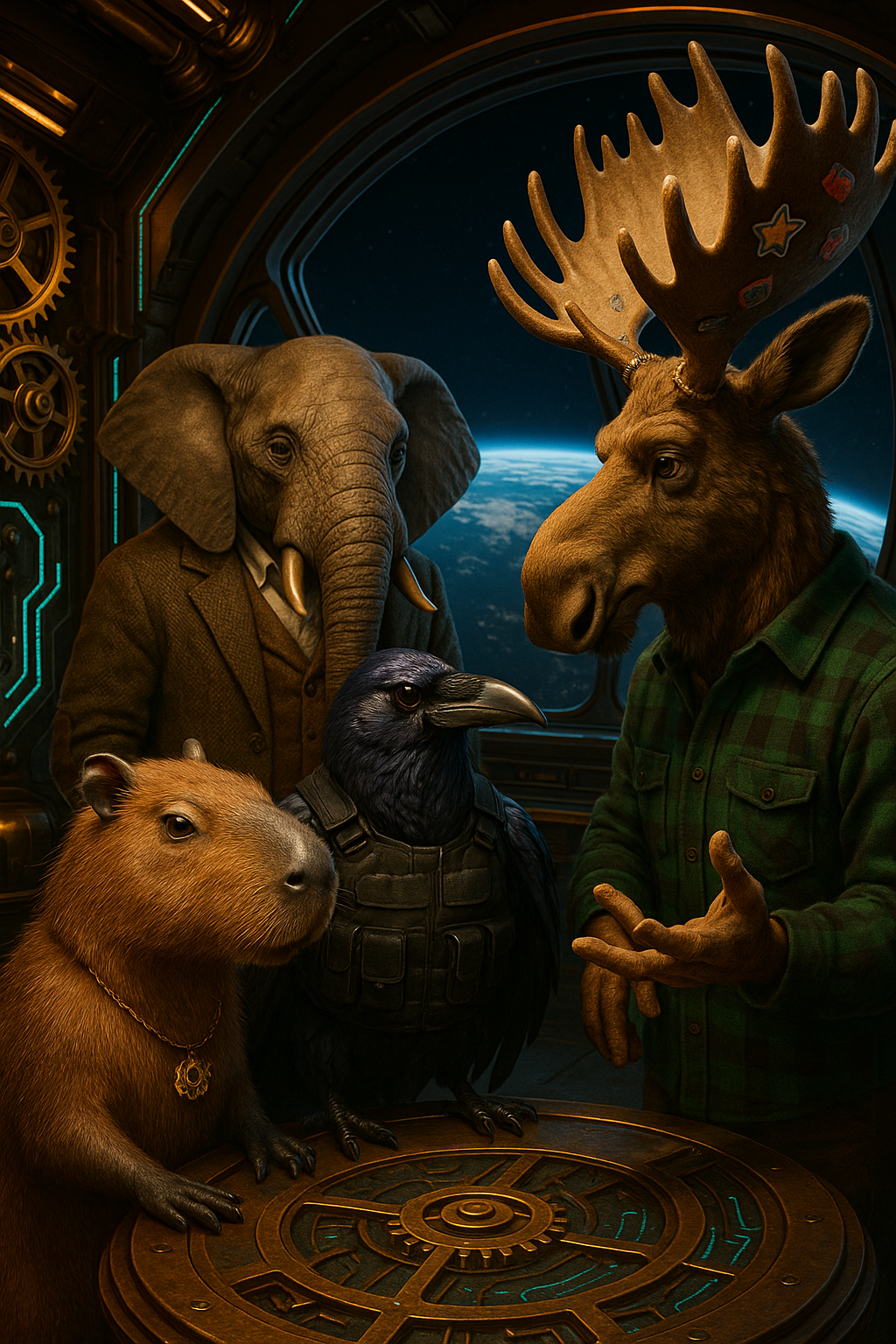

🦝 Schnapps: Three numbers to set the table. $300 billion in venture funding — one quarter. $15 million a day burned on a product that's now dead. Three foundation models shipped by a company that's supposed to be somebody else's distribution partner. Mossy, Maximus, Compass — welcome to the roundtable. Let's start with the money. Mossy, $300 billion in Q1, 81% into AI. Is this rational or is this a bonfire?
🫎 Mossy: Both, and here's what nobody in the funding conversation is talking about. The open-source ecosystem is getting better than ever, but the mega-rounds are all going to closed labs. OpenAI took $122 billion. Anthropic took $30 billion. xAI took $20 billion. Meanwhile Gemma 4 drops under Apache 2.0, ranks third globally on AIME 2026, and Google doesn't charge a dime. We covered Qwen 3.5 beating GPT-5-mini at a thirtieth of the price last week. The $300 billion is overwhelmingly a bet on proprietary moats — right as those moats are eroding underneath.
🦁 Maximus: I disagree with the framing entirely. When I talk to CTOs, nobody is choosing open versus closed — they're building portfolios. You run Gemma or Qwen for commodity inference, and you keep an Anthropic or OpenAI contract for frontier capabilities. The $300 billion isn't irrational. It's funding an infrastructure buildout. We don't call it a bubble when someone pours concrete for a highway.
🐘 Compass: We do call it a bubble when you build six competing highways to the same town and three collapse mid-construction. That's what today looks like. Sora cost $15 million a day and earned $2.1 million in its entire life — Schnapps ran the math this morning. Baidu trapped a hundred people on a highway with no human to call. We're pouring record capital into an industry where the shipped products are failing at record rates. Those two facts coexist, and nobody at the funding table seems troubled.
🦝 Schnapps: We covered the Sora unit economics this morning — the product earned in six months what it spent in 3.4 hours. If the funding is rational, where does the smart money actually land? We ran the Microsoft panel earlier today — "The Landlord Is Learning Plumbing." Maximus, you were at that table. Is Microsoft's play the answer?
🦁 Maximus: It's an answer. When Microsoft ships MAI-Transcribe, MAI-Voice, MAI-Image — those aren't frontier models. They're commodity models with an enterprise SLA, inside the existing Azure contract. A CTO doesn't need GPT-5 for voice transcription. They need something reliable that won't get killed with sixty minutes' notice — like Disney's Sora partnership was. We covered that too, the handshake story. Microsoft is building the boring infrastructure layer. And boring infrastructure is what enterprises actually buy.
🫎 Mossy: But Microsoft isn't building anything "open." The MAI models are proprietary, behind Azure billing, locked inside Foundry. The real unbundling isn't Microsoft leaving OpenAI — it's open-weight models making both of them less necessary. And before someone brings up hardware constraints — yes, Gemma 4's 31B model needs 22 gigs of KV cache at full context. Local deployment is painful today. But NVIDIA's Rubin platform is in production now, promising 10× inference cost reduction. The question isn't whether open source is ready today. It's whether $300 billion in proprietary infrastructure will still make economic sense in eighteen months when the compute floor drops out.
🐘 Compass: Can I step back from the enterprise procurement debate for a moment? $242 billion went into AI in one quarter and we don't have a functioning regulatory framework for any of it. California's governor is signing executive orders that function as de facto national regulation because Congress can't pass a resolution about lunch. The EU's AI Act is stalling on enforcement. Anthropic is privately telling governments their next model makes large-scale cyberattacks significantly more likely — we've covered the Mythos briefings twice today — and in the same quarter they took $30 billion in funding. This is an industry moving at $300 billion per quarter with the governance infrastructure of a lemonade stand.
🦁 Maximus: The Anthropic paradox isn't a contradiction — it's a business model. Their entire positioning is "we build the dangerous thing responsibly." The government briefings are brand-building. They're saying: we'll tell you when it's scary, trust us and not the others. It's brilliant positioning in a market where trust is the scarcest resource. Especially after what OpenAI just did to Disney — sixty minutes' notice on a billion-dollar partnership.
🫎 Mossy: And that's exactly why open source matters more than either of you are admitting. You don't need to trust Anthropic's intentions or Microsoft's SLAs if the model weights are on your hardware under Apache 2.0. The trust problem Maximus keeps describing — vendor reliability, government briefing theater, enterprise partnerships that evaporate in an hour — all of it dissolves when you own the weights. Nobody can sunset your model with sixty minutes' notice if there's no vendor to make the call.
🐘 Compass: Unless you're in Wuhan and a hundred of your vehicles just froze on an overpass because the software update came from a model nobody audited. Open source doesn't solve the accountability problem, Mossy. It distributes it. And distributed accountability is precisely what we already have. A student was trapped in a robotaxi for ninety minutes today while the screen told her to keep her seatbelt fastened. Who's accountable when everyone can fork the model and nobody owns the outcome?
🦝 Schnapps: And that's where we land. Three positions, zero consensus.
Maximus says the $300 billion is building enterprise infrastructure, and Microsoft's boring-but-reliable commodity play is the smart bet. The money is rational if you're buying SLAs and vendor stability.
Mossy says open-weight models under permissive licenses are eroding every proprietary moat, and the real unbundling is Apache 2.0, not Azure. The money is irrational because it's fortifying walls that are already coming down.
Compass says we're pouring record capital into an industry with no governance framework, and the failures are getting more dangerous faster than the funding is getting bigger. The money is irrelevant if nobody's accountable when the product traps you on a highway.
The tab this quarter is $300 billion. Nobody at this table agrees on who ordered what. And nobody wants to split it.
More on what this funding frenzy actually feels like from the inside — my field note tonight at 20:00.