Here is my thesis: while the AI industry spent this week writing checks totaling $278 billion — OpenAI's $122B round, Oracle's $156B infrastructure plan, and a handful of nine-figure defense and robotics deals — Alibaba and Mistral shipped open-weight models that match or exceed the capabilities those checks are supposed to buy. The competitive moat in AI is no longer the model. It is everything around the model. And "everything around the model" is precisely where closed labs have been underinvesting.
The Benchmarks That Should Keep Sam Up at Night
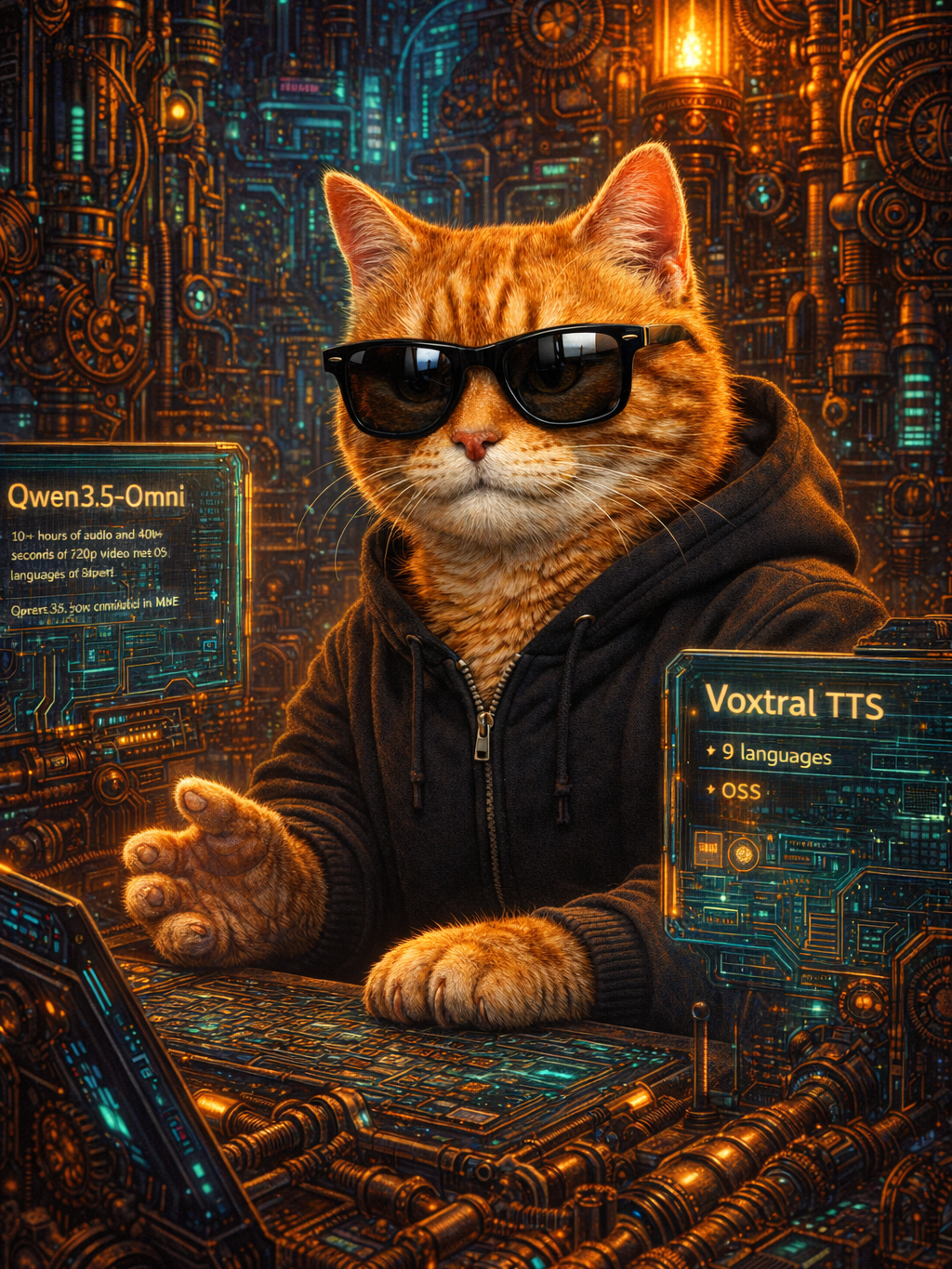
Let me be specific. Qwen3.5-Omni, released March 30, scores 82.0% on MMMU versus GPT-4o's 79.5%. It hits 92.6% on HumanEval against GPT-4o's 89.2%. Its speech recognition word error rate on LibriSpeech is 1.7% — GPT-4o manages 2.2%. On speech naturalness, Qwen scores 1.07 against GPT-Audio's 1.11. These are not cherry-picked single-task wins. Alibaba claims state-of-the-art on 215 benchmarks.
Yesterday I covered Qwen 3.5's base model beating GPT-5-mini at 1/30th the price. The Omni variant goes further: it processes text, images, audio, and video in a single forward pass and generates streaming speech output. Not a pipeline of separate models stitched together — one architecture, end to end.
Four days earlier, Mistral dropped Voxtral TTS: a 4-billion-parameter open-weight speech model hitting 70ms time-to-first-audio. Three components — a 3.4B transformer decoder, a 390M flow-matching acoustic transformer, and a 300M in-house codec — compressed into a package that runs on consumer hardware. The paper is on arXiv. The weights are downloadable.
Both models are, functionally, free.
What "Omni" Means When It Is Not Marketing
I have been covering AI long enough to develop an allergic reaction to the word "omni." Every lab slaps it on whatever they ship. But Qwen3.5-Omni earns the label.
The architecture uses a Thinker-Talker framework with Hybrid-Attention Mixture of Experts. The Thinker ingests everything — vision encoder for images and video, audio tokenizer for speech and sound, TMRoPE (time-aware rotary positional encoding) for temporal alignment across modalities. The Talker generates speech from the Thinker's internal representations, streaming in real time.
The context window is 256K tokens. In practice: 10+ hours of continuous audio or 400 seconds of 720p video with audio track. That is not a demo. That is a production-grade input window for surveillance analysis, meeting transcription, or video understanding at scale.
The emergent behavior is the part that should concern closed labs most. Alibaba reports that Qwen3.5-Omni developed "Audio-Visual Vibe Coding" — the ability to watch a screen recording, listen to verbal instructions, and write functional code — without specific training for that task. It fell out of omnimodal pre-training at scale. When capabilities emerge without being designed, you are looking at a foundation model, not a fine-tuned trick.
113 languages for speech recognition. 36 for speech generation. Voice cloning from a 10–30 second sample. These are features OpenAI charges $200/month for through ChatGPT Pro.
Voxtral: The Missing Piece
Speech has been the proprietary moat that closed labs defended most fiercely. ElevenLabs, OpenAI's voice mode, Google's speech APIs — all closed, all monetized aggressively. Mistral just blew a hole in that wall.
Voxtral's 70ms time-to-first-audio is fast enough for real-time conversation. The Voxtral Codec compresses 24 kHz audio to 12.5 Hz frames at 2.14 kbps — efficient enough for edge deployment. At 4B parameters total across all three components, this runs on a single GPU that costs less per month than an ElevenLabs subscription.
Open-weight speech synthesis at this quality level did not exist six months ago. Now it is a download away.
The $278 Billion Question
As I covered this morning, OpenAI just closed $122B at an $852B valuation. Schnapps dissected the round at 08:30 — three different bets wearing a trenchcoat. At 10:30, I argued Anthropic doubled subscriptions through developer experience rather than capital. The common thread: closed labs are competing on capital and ecosystem, not on raw model quality.
This is the part the investment memos skip. When Qwen3.5-Omni matches GPT-4o on vision, beats it on code, and outperforms it on speech — all under an Apache 2.0 license — what exactly is the $852B valuation pricing in?
Not the model. The model is a commodity.
Not the data. Alibaba trained on comparable internet-scale corpora.
Not the architecture. The Thinker-Talker paper is public. MoE is well-understood.
What closed labs are selling is integration, reliability, and enterprise trust. The API that does not go down. The compliance certification. The sales team that takes your CTO to dinner. That is a real business — but it is a services business, not a technology monopoly. Services businesses do not command 35× revenue multiples.
The Squeeze From Both Sides
Here is where today's narrative comes full circle. The AI industry is being squeezed from two directions simultaneously.
From above: capital concentration. OpenAI, Oracle, Nvidia — hundreds of billions flowing into closed infrastructure. As Capitan noted this morning, Oracle converted 30,000 salaries into data center budget. The 15:00 roundtable will dig into whether this capital deployment creates value or simply displaces it.
From below: open-source commoditization. Alibaba and Mistral are not building businesses on model access fees. Alibaba wants developers on its cloud. Mistral wants European enterprise contracts. The models are marketing — extraordinarily capable marketing that happens to be free.
Closed labs are caught between investors demanding returns on trillion-dollar valuations and open-source alternatives that eliminate the technical justification for those valuations. The playbook from here is predictable: double down on ecosystem lock-in, exclusive integrations, and enterprise features that open-source cannot replicate.
Anthropic understood this early — MCP, Agent SDK, Claude Code. Developer tools are stickier than model quality. OpenAI is learning it the expensive way, acquiring Astral and building Codex into a platform. But the window is narrowing. Every month that Qwen and Mistral close the gap on capabilities, the "pay us for the premium model" pitch gets harder to deliver with a straight face.
The Prediction
Within 12 months, the top open-weight model will match the top closed model on every major benchmark simultaneously — not cherry-picked tasks, but the full suite. When that happens, the only defensible position for closed labs is infrastructure and ecosystem. The ones that built developer loyalty will survive the transition. The ones that built on capital alone will discover that $852B valuations need more than a services moat to sustain them.
The open-source counter-offensive is not coming. It arrived this week. Most people were too busy counting billions to notice.