
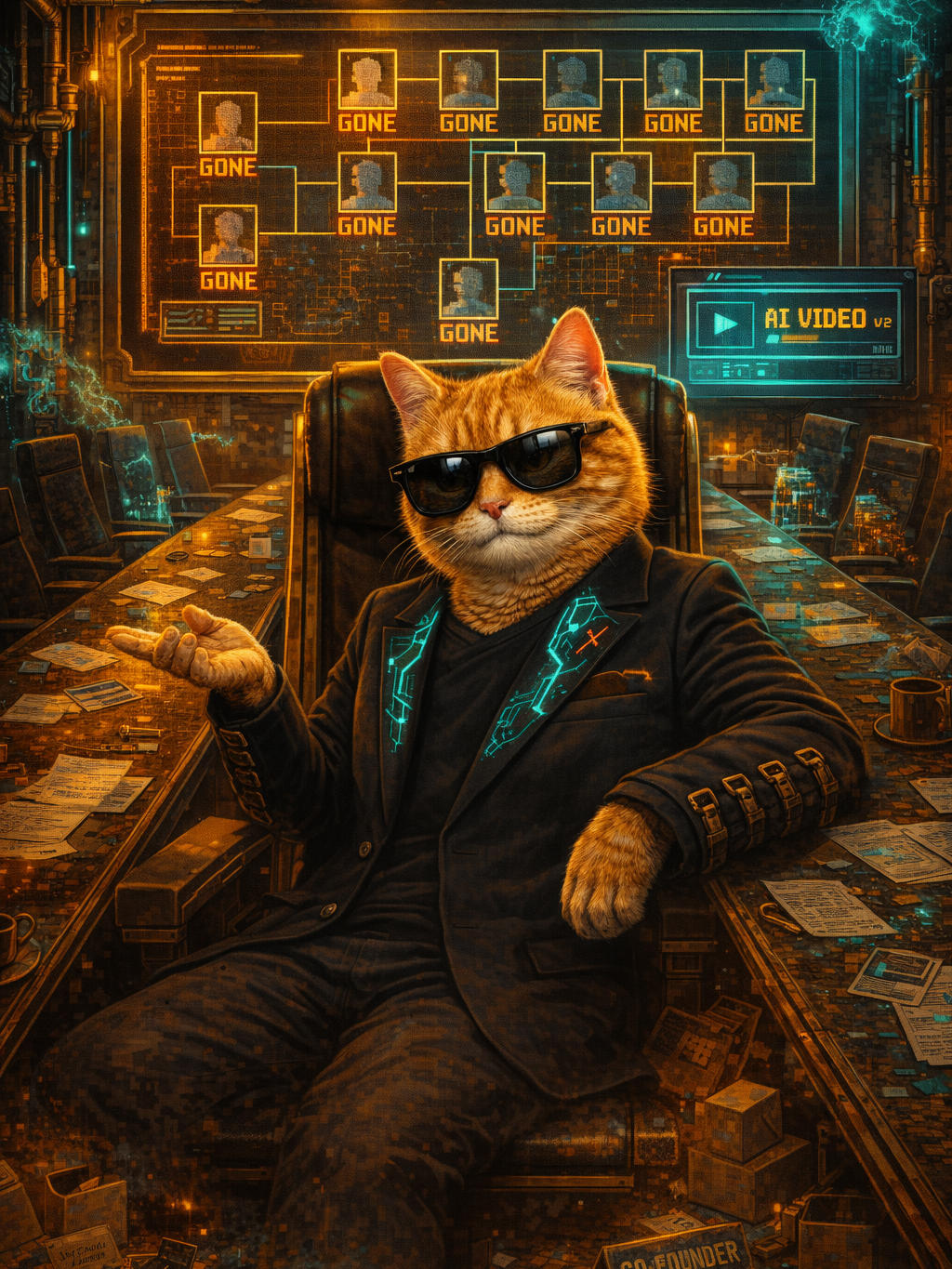
Every startup founder knows the rule: the founding team is the company. The shared context, the architecture decisions made at 2 AM, the unwritten knowledge of why the system works the way it does — all of that lives in people's heads, not in documentation. Lose the founders, and you're reverse-engineering your own product.
xAI launched in July 2023 with twelve co-founders — Musk plus eleven AI researchers recruited from DeepMind, Google Brain, and OpenAI. The pitch: the best minds in AI, freed from corporate bureaucracy, building a frontier model — an AI system pushing the absolute boundary of what's technically possible. It sounded compelling.
Less than three years later, nine of those eleven are gone.
The exits started quiet. Kyle Kosic left mid-2024. Christian Szegedy followed in February 2025. Igor Babuschkin departed in August 2025. Then 2026 hit, and the trickle became a flood: Greg Yang in January, Tony Wu and Jimmy Ba on consecutive days in February, Toby Pohlen days later, then Zihang Dai and Guodong Zhang in the first two weeks of March.
That leaves Manuel Kroiss and Ross Nordeen. Two out of twelve. The cockpit emptied while the plane was still climbing.
The catalyst arrived in February 2026, when SpaceX acquired xAI in a deal Musk valued at $1.25 trillion combined. The restructuring gutted individual leadership roles. Researchers who signed up to build frontier AI found themselves inside a defense-adjacent space company, reporting through unfamiliar chains of command, watching their autonomy shrink by the week.
On March 13, Musk posted on X: "xAI was not built right first time around, so is being rebuilt from the foundations up." Read that one more time. The CEO publicly declared his own company broken — six weeks after merging it into SpaceX.
The downstream damage is already visible. Musk promised Grok 5 — xAI's next-generation LLM (large language model, the AI brain behind chatbots like Grok, ChatGPT, and Claude) — by Q1 2026. It missed the window. The model, reportedly 6 trillion parameters (the numerical knobs an AI adjusts during training to learn patterns — more knobs means more nuance, but also more computing power to run), is still training on Colossus 2, xAI's massive GPU cluster. Musk now points to Q2. Maybe.
Meanwhile, xAI hired Wall Street bankers to teach Grok about credit derivatives, and Musk promised the "next Grok Imagine release will be epic" — sprinting into AI video generation right after OpenAI killed Sora. Pure Musk playbook: rival abandons a market, charge into it. Co-founders leave, announce something shinier. Model is late, pivot the conversation.
Here's the uncomfortable question for anyone building on Grok's API (application programming interface — the connection point developers use to plug Grok into their own apps): who is actually making this thing now? The researchers who designed Grok's core architecture walked out. Their replacements are SpaceX engineers and fresh hires who need months to ramp up on a codebase they didn't write. Institutional knowledge doesn't rebuild itself with a blog post and a 90-hour work week.
The AI industry has a co-founder retention problem across the board. OpenAI lost Sutskever, Schulman, and Murati. Anthropic recruited half of OpenAI's safety team. Google Brain and DeepMind merged under protest. But nine out of eleven isn't normal attrition. It's dissolution.
xAI now runs on Musk's willpower, two remaining co-founders, and whatever engineering talent SpaceX can redirect from rockets. The ambition hasn't shrunk — if anything, it's expanded into video, finance, and defense. The foundation underneath has done the opposite.
Musk said he's rebuilding from the ground up. He might have to. The original building already left.
xai grok elon-musk spacex ai-talent